What’s Your One Shining Moment?


Betsy Nabel speaks to BWHers at Town Meeting.
The Nov. 22 Town Meeting covered a number of questions on a wide range of topics submitted by BWHers.
One BWHer expressed concern that the current political climate in the U.S. may pose a risk to civil liberties and asked BWHC President Betsy Nabel, MD, how the hospital will respond. Nabel stressed that the Brigham will keep its doors open to all and maintain a culture of respect.
“I can assure you, as your leader, that I will not tolerate discrimination, bias or disrespectful behavior – it’s not who we are,” Nabel said to those gathered in Bornstein Amphitheater and more than 250 employees who watched via webcast.
“We are a diverse community, and our diversity makes us richer,” she continued. “We can’t provide exceptional care to our patients unless we, as care providers, are diverse. That means being tolerant, open and accepting of one another. Those have been our values since our hospital opened, and they will continue to be our values for years to come.”
Other topics that Nabel addressed during the meeting included updates about the budget, benefits and Partners 2.0.
Reflecting on the past year, Nabel said she’s proud of how BWHers have worked together to overcome challenges the hospital has faced, all with an unwavering commitment to our mission. These accomplishments resulted in the Brigham ending fiscal year 2016 ahead of budget, and Nabel announced a one-time employee appreciation award to staff who met certain requirements.
“As a result of your hard work, the Brigham continued to make great strides in delivering the highest-quality patient care, advancing discovery and innovation in research, training the next generation of health care professionals and improving the health of the communities we serve,” she said.
Nabel also shared a brief update about Partners 2.0, an initiative that will help BWHC and other Partners institutions respond to changes in the industry and maintain a strong financial foundation. She outlined the three phases of Partners 2.0: diagnosis, design and implementation. Partners is currently in the diagnosis phase, which involves assessing needs, challenges, strengths and areas for improvement. Nabel said there would be more updates to come about the process, but noted that the key to its success is a willingness among staff to embrace change.
Other questions from the audience concerned recent changes to BWHC’s retirement program. Paul Cheney, director of Benefits at Partners, detailed the updates, which include a new employer match in the pretax retirement savings plan.
Also during the meeting, Nabel introduced Dave Corbin, CPP, CHPA, BWH’s new director of Security, and thanked outgoing director Robert “Chico” Chicarello for his 42 years of service. The audience erupted in applause and gave a standing ovation to Chicarello, who retired last week.
“It’s my honor and privilege to take the reins from Chico. I know I have very big shoes to fill,” Corbin said. “My goal is to make sure that when our employees and patients come to the Brigham, they feel safe and know that Security is a resource for them.”
Click here to view a recording of the webcast.
Coming Soon: BWH Patient Safety Culture Survey
On Monday, Nov. 28, BWH staff whose work directly affects patient care will be asked to complete a survey to assess BWH’s culture of patient safety. The confidential BWH Patient Safety Culture Survey will be distributed via email from Pascal Metrics with a link for online completion. The information that you provide will help BWH continue to advance the culture of safety throughout the institution.
Donate to the United Way Campaign and Win Prizes
The 2016 campaign runs through Tuesday, Nov. 22. Donors have the opportunity to win a host of exciting prizes, including a New England Patriots helmet signed by wide receiver Julian Edelman, Bruins tickets, a Nest thermostat and more. Learn more at BWHPikeNotes.org.
New Retirement Program: Learn More
The Benefits Office will hold 45-minute information sessions about the changes to the retirement program for weekly-paid BWH and BWPO employees and BWH research scientists/senior research scientists and associates, effective Jan. 1, 2017. These sessions are not intended for BWH and BWPO professional staff/faculty. Upcoming sessions take place Monday, Nov. 21, at 5 p.m., and Tuesday, Nov. 22, at 7:30 a.m., in the Duncan Reid Conference Room. Visit BWHPikeNotes.org to learn more.
Nominate a Colleague to the Brigham Way
The Brigham Way is about going above and beyond what is required of you to make BWH a better place for all who come through our doors. Tell us about how you or one of your colleagues go above and beyond, and your nomination could be featured on PikeNotes and TV screens across the distributed campus. Email your nomination to TheBrighamWay@partners.org.
Have You Lost 10 lbs. in the Past 1.5 Years?
Jason Block, MD, of BWH’s Department of Medicine and the Harvard Pilgrim Health Care Institute, is conducting a research study that uses financial incentives to encourage employees who have lost at least 10 pounds in the past one and a half years to keep the lost weight off. Participants will complete two brief surveys and weekly weigh-ins for one year at several locations on the BWH campus. To participate or learn more, contact Michael Seward at 617-867-4419, or email BWHealth@harvardpilgrim.org.
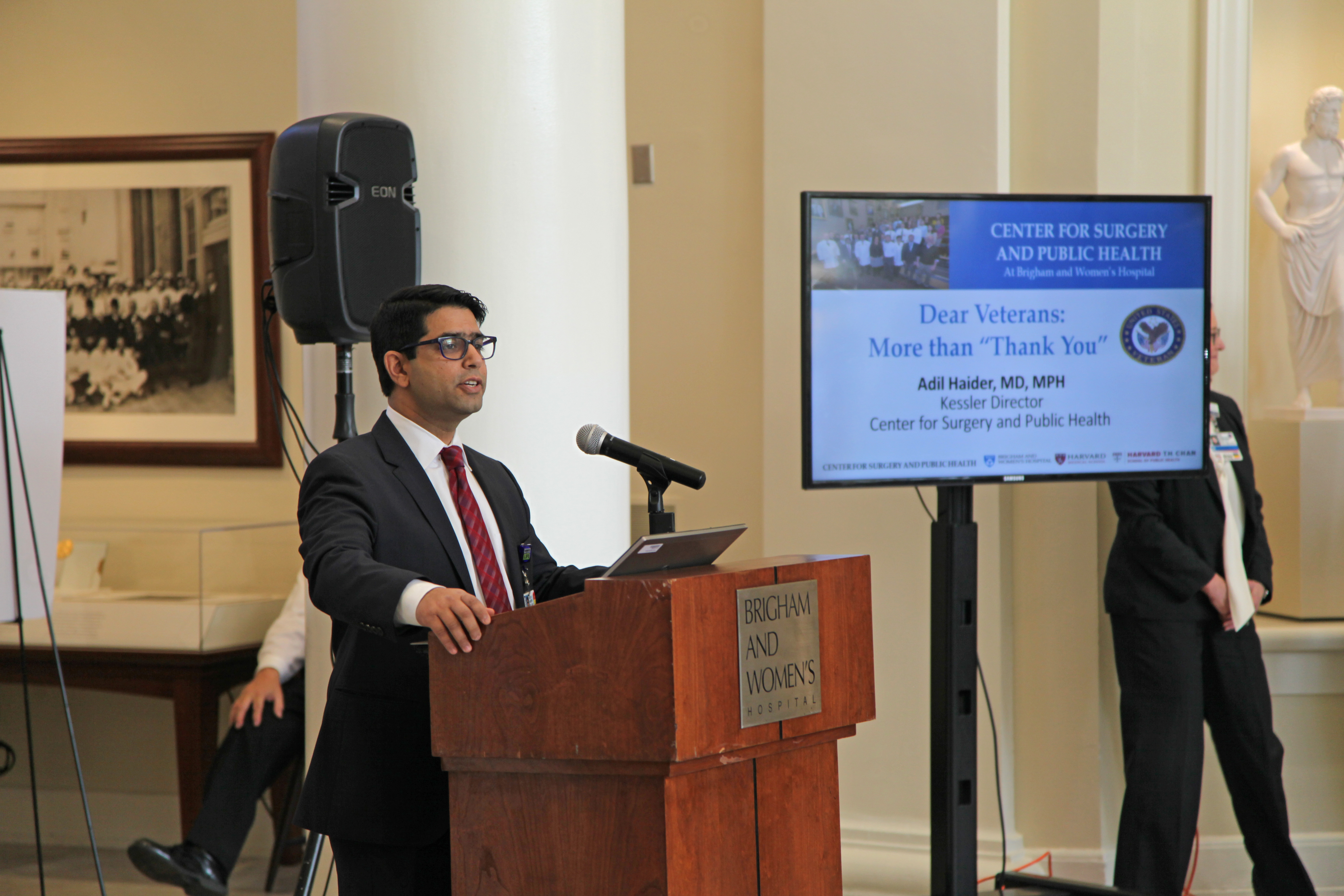
Adil Haider talks about trauma care during BWH’s Veterans Day event.
BWHers came together on Nov. 11 to celebrate and honor America’s veterans and active duty members of the military during a ceremony in the 15 Francis St. lobby.
U.S. Navy veteran Eric Goralnick, MD, MS, medical director of Emergency Preparedness, and Lisa Morrissey, DNP, MBA, RN, NEA-BC, interim chief nursing officer and senior vice president of Patient Care Services, thanked veterans and military personnel for their service and sacrifice.

From left: BWHers and military veterans Richard Wong and Luis Muñoz, of the U.S. Coast Guard, and Eric Goralnick, of the U.S. Navy
“For well over 200 years, ordinary men and women have found, within their hearts, the strength and courage to act in extraordinary and heroic ways, inspired by their belief in the American dream and in gratitude for the promise and opportunity afforded by this great country,” Morrissey said.
The gathering kicked off with the national anthem, followed by remarks from Adil Haider, MD, MPH, Kessler director of the Center for Surgery and Public Health, about the adoption of military advances in trauma care and the CSPH’s work in this area.
The event concluded on a sweet note, with the cutting of the signature BWH Veterans Day American flag cake, prepared by Tower Catering.

Ayesca Machado displays the flu shot sticker on her ID badge.
Surrounded by toddlers all day at the child care center where she once worked, Ayesca Machado thought she ought to get the flu shot so that she wouldn’t be sick around the children.
A week after getting the vaccine, though, she got sick. It didn’t feel like the flu, but it was a lot worse than the sniffles, she recalls. Machado, like many people, came to believe the myth that the flu vaccine caused the flu.
“I was like, ‘Nope, I’m done. I’m not doing that again,’” Machado said.
But when she started an internship with BWH’s Department of Quality of Safety this past January – and saw how important the flu vaccination program was at the Brigham – she opened her mind to revisiting her position on the flu shot. Machado sat down with a nurse practitioner in Occupational Health Services and shared why she was reluctant to get vaccinated against the influenza virus. Learning the facts about the flu vaccine compelled Machado to reconsider.
“She explained to me that a couple different scenarios could have happened. For example, I could have already had the flu virus,” said Machado, now a practice assistant at BWH’s Orthopaedic and Arthritis Center. “She just put my mind at ease.”
Machado got her flu shot in January, and she just got vaccinated again in September for this flu season. The result: “Other than a sore arm for a couple of days, I’m fine,” she said.

Mayra Guerrero de Rosario, of Environmental Services, gets ready to receive her flu shot from nurse practitioner Coleen Caster.
The flu vaccine contains no live viruses, making it impossible to transmit the flu. In fact, the Centers for Disease Control and Prevention say that getting the flu shot may make your illness milder if you do get sick.
In addition, the protective effects of the flu shot don’t kick in until about two weeks after being vaccinated. This gap means it’s possible to get the flu before the vaccine has had enough time to provide protection. For this reason, the sooner you receive a flu shot, the more likely you’ll be protected from the virus.
Still, 25 percent of BWHers who declined to get vaccinated last flu season made that decision based on their belief that the flu vaccine can cause the flu or made them sick in the past.
Flu vaccination rates at the Brigham hit their highest levels ever last year, with 90 percent of BWHC staff receiving the vaccine. BWH is aiming for an even higher rate for the 2016-2017 flu season to further improve patient safety and protect all members of the BWH community from the spread of disease.
Among those who declined to receive the vaccine for the 2015-2016 flu season, the most common reason given during the attestation process was grounded in another myth: that they didn’t need a flu shot or never get the flu (37 percent). However, no one is immune to the influenza virus. Infectious disease experts say that not having had the flu previously doesn’t mean you have an innate resistance to the virus.
Mark MacMillan, grants administrator in the Center for Excellence in Vascular Biology, acknowledged he used to be one of those people who thought he could never get the flu. Eventually, he did – and has been getting an annual flu shot ever since.
“After enduring a fever that got to 104 degrees and symptoms that had me flat out for a few days, I came to understand two things,” he said. “One, at the risk of sounding hyperbolic, I understood that people have died and still can die of influenza, and two, if possible, I never want to go through that again and will do anything to prevent it.”
Similarly, Machado decided that getting vaccinated each year was something she could do to help ensure patients receive care in the safest environment possible.
“Working in a hospital, you should be aware not only of yourself but also the patients you come in contact with. Even if you’ve never gotten the flu or if you believe that it wouldn’t be so bad if you did, it could be much worse for a patient,” Machado said.
Learn more about how you can get your flu shot and about BWH’s flu vaccination policy at BWHPikeNotes.org.
 BWHC’s Strategy in Action: Highest-Quality, Safe Care
What convinced you to get a flu shot? Share your story in the comment section below.
Bold Ideas, Big Savings Program
In a hospital-wide effort to reduce costs and improve efficiency, BWH launched the Bold Ideas, Big Savings program. BWHers are encouraged to submit any and all cost-savings ideas. If the idea is chosen and implemented, the individual or team that submitted the idea will be awarded a cash prize. Each idea is reviewed by the Bold Ideas, Big Savings committee to ensure it meets eligibility requirements of originality and feasibility. Learn more at BoldIdeasBigSavings.org.
Town Meeting, Nov. 22
Join BWHC President Betsy Nabel, MD, for the next Town Meeting: An Open Forum for BWHers on Tuesday, Nov. 22, noon-1 p.m., in Bornstein Amphitheater. Nabel will provide an update on top-of-mind issues, followed by an open forum for discussion. What would you like to hear about at Town Meeting? Submit your questions or topics of interest in advance by completing this brief survey.
Open Enrollment for 2017 Benefits
From now until Tuesday, Nov. 22, benefits-eligible employees can update their health, life and other employee benefits for 2017. Changes you make during open enrollment become effective Jan. 1, 2017. Visit BWHPikeNotes.org for more information.
Integrative Medicine Network Forum, Nov. 18
The Osher Center for Integrative Medicine is holding an Integrative Medicine Network Forum, at which researchers, educators and clinicians with interests in integrative medicine will meet, share ideas and explore future collaborations. Friday, Nov. 18, 8 a.m.-2 p.m., at Harvard Medical School’s Joseph B. Martin Conference Center, 77 Avenue Louis Pasteur. Visit oshercenter.org to register.

Therese Breen selects gifts at the Shop on the Pike to donate to the Toys for Tots program.
Two incentives offered by the BWH Shop on the Pike – a loyalty program and the ability to make purchases via payroll deduction – are big reasons why shoppers such as Cathy Rumble, MS, RN, visit frequently.
Rumble, nursing director of the Float Pool, made sure to enroll in the shop’s rewards program and payroll deduction as soon as she heard about them several years ago. She stops by the shop often to take advantage of the great sales and to check out new items.
“The two programs benefit the customers,” Rumble said. “I love the fact that when I go visit the shop, I only need to bring my Brigham badge. When I receive a coupon at the register, I look forward to returning to use it.”
Customers enrolled in the Shop on the Pike’s loyalty program, known as Pike Pass, earn one point for every dollar spent. Once a shopper earns 150 points, they receive a $15 coupon for a future purchase. More information about the Pike Pass program is available by visiting the Shop on the Pike.
“Who doesn’t love coupons?” asked Patrick Lally, retail manager at the Shop on the Pike. “The Pike Pass program is great because regardless of how you pay, you’ll earn points.”
All customers who are interested in the Pike Pass can visit the gift shop to sign up. The program tracks points using a customer’s email address or phone number.
Therese Breen, manager in Materials Management, who participates in the shop’s rewards program, loves visiting the shop to find gifts for birthdays and the holidays. She stopped in recently to pick up some items to donate to the Toys for Tots program.
“The rewards program is great any time of the year, but that’s especially true around the holidays. Knowing I have an extra $15 to spend on a gift goes a long way,” Breen said. “I’ve been a customer for a long time, and the shop’s rewards program is one of the main reasons I keep coming back.”
Wallet-free Shopping with Payroll Deduction
Another program the Shop on Pike offers is the ability to make purchases using payroll deduction.
Staff registered for payroll deduction at the gift shop can use their BWH identification badge to make purchases of $10 or more; gift cards are excluded from the program. Money is deducted from your paycheck during the next pay period.
Lally said the program has become very popular, since many staffers do not carry wallets, cash or credit cards during shifts.
“We want to make shopping here as convenient as possible,” he said.
Staff can sign up for payroll deduction by visiting the Shop on the Pike to scan their ID badge and provide a few additional details, including their name, employee ID number and an email address or phone number.
One added bonus: Once registered for payroll deduction, staff will automatically be entered into the Pike Pass program.
BWH Food Services also Offers Payroll Deduction
The Shop on the Pike isn’t the only place at the Brigham where you can pay with your ID badge. Staff may also sign up for payroll deduction through BWH Food Services.
Once registered, staff can pay for food and drinks via payroll deduction at the Garden Cafe, the Coffee Connection at 45 Francis St. and the new cafe in the Building for Transformative Medicine – simply by swiping their ID badge. Sign up at any one of these three dining sites; be sure to bring your ID badge.
Food Services’ payroll deduction program is not connected to the Shop on the Pike’s program; each requires a separate registration.
 As Veterans Day approached, BWH Director of Security and Parking Robert Chicarello looked at his calendar and thought one thing would make the day extra special: finally identifying the owner of a U.S. Army ring brought to the hospital’s lost and found several years ago.
After photos of the ring were shared on the Brigham’s Facebook page last week, nearly 90 people responded. Some offered to share the post with their networks, while others made observations about the ring’s insignias that provide clues about its owner’s past military service. The Facebook post received more than 2,400 shares and was covered by several local media outlets.
The ring, engraved with the initials R.E.Z., was found at 75 Francis St. On one side, it bears the “Screaming Eagle” of the 101st Airborne Division. On the other side is the insignia for the 18th Military Police Brigade – a sword and axe inside a shield – stationed in Germany. It appears to have no identifying marks indicating when the soldier, presumably a military police officer, served.
BWH Security and Parking made several attempts to locate the ring’s owner when it was first found, but names provided during this search did not correlate to any BWH patients.
After reviewing the tips and leads received from the Facebook post, BWH Security and Parking reached out to the 101st Airborne Division Association to see if they could help identify its owner. The association could not find a match for the initials in its roster, although not all members of the division belong to the association. The search for the owner is ongoing.
Chicarello said he hoped to find the ring’s owner in time for this Veterans Day and as one last act of service to the BWH community before he retires on Nov. 18. He was inspired to reach out to BWH’s online communities after seeing a news story several weeks ago about Randolph Police Department’s success using social media to locate relatives of a World War I veteran whose dog tags were found in town.
“When we first found the ring, social media wasn’t what it is now. There just seemed like a better chance this could get shared with the right person or group,” he said. “It’s not like this ring is just a gold band with nothing on it – this has identifying marks. You know it was someone’s Army ring and was very meaningful to that person.”
Anyone with information about the ring’s potential owner is asked to contact BWH Security and Parking at 617-732-6001.
Shop on the Pike Sale
It’s a great time to update your BWH wardrobe at The Shop on the Pike. The shop is retiring some classic clothing items, which are now 25 percent off. Discounted items are being displayed at the front of the shop now until Monday, Nov. 14. New clothing styles and colors will be added in the coming weeks.
BWH Stepping Strong Marathon Team
Only a few spots remain on the 2017 BWH Stepping Strong Boston Marathon Team. Don’t delay – apply today and run with an inspired community dedicated to transforming outcomes for patients and families affected by traumatic injuries and events. Click here to learn more.
Got a flu shot for the first time? We want to hear from you
BWH Bulletin is looking to hear from Brigham staff who got their flu vaccine for the first time recently. Share your thoughts about what convinced you to start getting a flu shot, and your answer may be featured in an upcoming issue of BWH Bulletin. Send your answer to bwhbulletin@partners.org.
What Are You Thankful for This Year?
BWH Clinical & Research News’ “Look Who’s Talking” feature includes voices from across BWH answering the same question. The question for our November/December issue is, “What are you thankful for this year?” To share your answer, email bwhclinicalandresearchnews@partners.org.
Veterans Day Celebration, Nov. 11
Join BWH in honoring veterans during its annual Veterans Day ceremony on Friday, Nov. 11, at noon, in the 15 Francis St. lobby. Adil Haider, MD, MPH, Kessler Director of the Center for Surgery and Public Health (CSPH), will speak about the adoption of military advances in trauma care and the CSPH’s work in this area. Cake will be served following the ceremony. All are welcome to attend.

Thanks to worldwide support from individuals and organizations who share the Brigham’s commitment to transforming patient care, BWH’s Life.Giving.Breakthroughs. campaign surpassed its original $1 billion goal earlier this month – two years ahead of schedule.
The campaign is now reaching even higher, with a new goal of $1.5 billion, recently approved by the BWH Board of Trustees and Campaign Cabinet, in order to continue supporting life-giving breakthroughs and advancements at the Brigham.
“With so much momentum and progress, we have no intention of slowing down,” said BWHC President Betsy Nabel, MD. “Our extended campaign goal will help us leverage the groundbreaking advances taking place in translational medicine today, bringing us closer to the day when we won’t have to watch our loved ones suffer debilitating and painful conditions that disrupt daily lives and rob us of so much.”
The campaign, launched in 2013 to tackle health care’s greatest challenges and transform the future of medicine, has paved the way for several projects, including:
The Building for Transformative Medicine, carefully designed and constructed to foster collaboration between clinicians and researchers.
The renovation and expansion of the Neonatal Intensive Care Unit, allowing BWH to provide more personalized, precise care to our tiniest, most vulnerable patients and their families.
The launch of the Ann Romney Center for Neurologic Diseases, dedicated to accelerating treatments, prevention and cures for the world’s most complex neurologic diseases.
The establishment of the Gillian Reny Stepping Strong Center for Trauma Innovation, dedicated to catalyzing innovations in trauma care to benefit military personnel and civilians affected by traumatic injuries.

Robert Califf and Betsy Nabel discuss the FDA’s need for feedback from experts at academic medical centers, such as the Brigham.
On Nov. 1, Robert Califf, MD, commissioner of Food and Drugs at the U.S. Food and Drug Administration, visited the Brigham and spoke about several topics that were top of mind for the FDA and BWHers, including the need to expand the scientific workforce, improve mental health care and address the opioid crisis.
Califf was joined by BWHC President Betsy Nabel, MD, for the discussion in the Building for Transformative Medicine. The event was open to all BWH staff. Califf, who was named commissioner earlier this year, is traveling around the country to visit academic medical centers and learn more about their work.
“Dr. Califf’s visit provided great insight into what we can achieve when we work collaboratively,” Nabel said. “Today was only the beginning of what I hope is an ongoing conversation and exchange of ideas.”
During the discussion, Califf, who previously worked at Duke University as a cardiologist and clinical researcher, emphasized the FDA’s need for feedback from clinicians and researchers to help guide the agency’s policies. As the FDA works on several different priorities, having insights from experts in various areas of science and medicine is imperative, he said.
“Since I began working at the FDA, it has become obvious that a lot of our work is very dependent on the people who are either trained in academic medical centers or who receive care through these enormous integrated health systems that are evolving around academic medical centers,” he said. “Certainly, Partners HealthCare is an early and premiere example of this phenomenon.”
The FDA is responsible for protecting public health by ensuring the safety, efficacy and security of human and veterinary drugs, biological products and medical devices.
As commissioner, Califf said his top priority is building up the scientific workforce to ensure the FDA continues to make informed policy decisions.
“We need a vibrant ecosystem, which is cognizant of benefits and risks and continually interacting with the FDA,” Califf said. “We need to constantly update the knowledge base so we can do the right thing.”
The forum concluded with questions from BWHers. Brian Mullen, PhD, Innovation Strategy manager in the Brigham Innovation Hub, asked about the regulation of technologies, such as apps and games, to improve mental health. Apps and games need to be regulated to ensure that people are not buying products that don’t work, Califf responded.
Mental health and substance abuse are top-of-mind issues for the FDA, Califf added, acknowledging that the federal government needs to continue improving its work in those areas.
“Problems like depression are chronic, and while there are behavioral and social components, there’s also a need for much better pharmacologic therapies,” Califf said. “We need to invest in developing the pipeline much like we did with cancer 45 years ago.”
Califf also spoke about the opioid crisis and referenced the FDA’s comprehensive action plan, available online at fda.gov, which outlines the steps the agency is taking toward reducing opioid misuse and abuse. He said the focus needs to be on increasing the number of prescribers who are trained in pain management and appropriate ways to prescribe opioids.
“There has to be a nonaddictive way to pharmacologically treat pain,” he said. “We all have to work together to figure this out.”
Michael S. Sinha, MD, JD, MPH, a postdoctoral fellow in the Program on Regulation, Therapeutics and Law at BWH, attended the talk because he is part of a research team in the Division of Pharmacoepidemiology and Pharmacoeconomics at BWH. The division conducts empirical research – a type of research based on observations in the field, as opposed to laboratory work – and legal policy analysis in the pharmaceutical industry. He enjoyed the candid discussion with the commissioner.
“We have a lot of respect for the FDA and its work,” Sinha said. “Dr. Califf joined the FDA after a long career in academic cardiology at Duke, and I admire his willingness to step into a position, for which criticism is abundant and praise is rare, with an opportunity to positively impact the regulatory landscape in the United States.”
Veterans Day Celebration at BWH, Nov. 11
Join BWH in honoring veterans during its annual Veterans Day ceremony on Friday, Nov. 11, at noon, in the 15 Francis St. lobby. Adil Haider, MD, MPH, Kessler Director of the Center for Surgery and Public Health (CSPH), will speak about the adoption of military advances in trauma care and the CSPH’s work in this area. Cake will be served following the ceremony. All are welcome to attend.
Survey: How Do You Commute to Work?
BWH must complete an online employee commuter survey in accordance with the Massachusetts Rideshare Regulation, which supports the state’s plan to reduce air pollution. The survey requires at least 50 percent of staff to respond. BWH Security and Parking hopes to capture your travel patterns for the week of Oct. 31. All participants will be entered into a raffle for a chance to win a month’s free parking (or MBTA pass) or one of five $50 American Express gift cards. Click here to take the survey. The deadline for completion is Monday, Nov. 7.
Register for Discover Brigham
Discover Brigham brings together our community with the broader Boston health care ecosystem to educate and inspire collaboration around innovative science, technology and medicine. Thematic sessions will highlight the work on cutting-edge topics spanning research and clinical disciplines with the potential to change health care. The theme of Discover Brigham this year is “Collaborate, Accelerate and Translate” as a reflection of similar goals for the Building for Transformative Medicine. Discover Brigham is hosted by the Brigham Research Institute. This event is open to the public. Thursday, Nov. 10, 11 a.m.- 6 p.m. Visit DiscoverBrigham.org to register.
Partners HealthCare Patient Reported Outcome Measures Summit
The second annual Partners Patient Reported Outcome Measures (PROMs) Summit continues the work of the Partners PROMs program to demonstrate the value of using PROMs data in direct patient care. Aggregated PROMs data is also used to inform joint decision-making, clinical quality improvement and value demonstration. The summit takes place Thursday, Nov. 17, at the Sheraton Boston Hotel, 39 Walton St. It is free to attend (parking not included), with breakfast and lunch provided. Visit BWHPikeNotes.org for more information and to register.
Annual Service of Remembrance, Oct. 23
Hosted by the BWH Center for Women and Newborns and CWN Bereavement Committee, this service supports families and staff who have experienced the loss of a baby during or after pregnancy and honors the babies who have passed away. Sunday, Oct. 23, in Cabot Atrium, with registration from 1:30–2 p.m., and the service at 2 p.m. Reception with light refreshments to follow. Free parking is available at 45 Francis St. Email lmorette@partners.org with questions.
Volunteer to Be a BWH Pen Pal
The Center for Community Health and Health Equity (CCHHE) is seeking staff to volunteer as pen pals to students in nearby elementary schools. Pen pals will receive and write one letter every other month and meet their pen pal twice at the school. All correspondence goes through CCHHE staff. To learn more, contact Pamela Audeh at 617-264-8740, or email paudeh@partners.org.
Event With FDA Commissioner Califf, Nov. 1
At a special event with Food and Drug Administration (FDA) Commissioner Robert Califf, MD, and BWHC President Betsy Nabel, MD, learn more about top-of-mind issues for the FDA and have your questions answered. Tuesday, Nov. 1, 9:30–10:30 a.m., in the third-floor conference center of the Building for Transformative Medicine, 60 Fenwood Road. This event is open to all members of the Brigham community.
Explore History of BWH on New Archives Site
The BWH Archives and BWH Medical Library have assembled a new website containing resources relating to the history of the Brigham. The site includes links to the BWH Archives and digitized historical documents. Click here for more information.
Are you ready for the Epic upgrade? The Partners eCare team will be implementing the Epic version 2015 upgrade on Saturday, Oct. 22. This update will introduce new features and functionality, as well as make the platform easier to use. Informational materials to help guide users through the most significant changes are available on the BWHC Communication and Training site.
BWHC will also move all Radiology appointment scheduling to Epic on Oct. 22 via a new module being added to Partners eCare. To avoid service interruptions and ensure a smooth transition to this new system, all staff who schedule Radiology exams must complete assigned eLearnings in HealthStream by Friday, Oct. 21 or prior to the next time they are on service.
Have You Heard About the Expert User Network?
Expert users will be available in all departments to assist PeC users who need support with upgrade-specific changes. If you need assistance after the Epic update is complete, contact the expert user in your department. Expert users will be wearing bright orange lanyards identifying them as a “BWHC Expert User.” If you cannot find your expert user, please follow the Issue Escalation Process found here or contact the Help Desk at 617-732-5927.
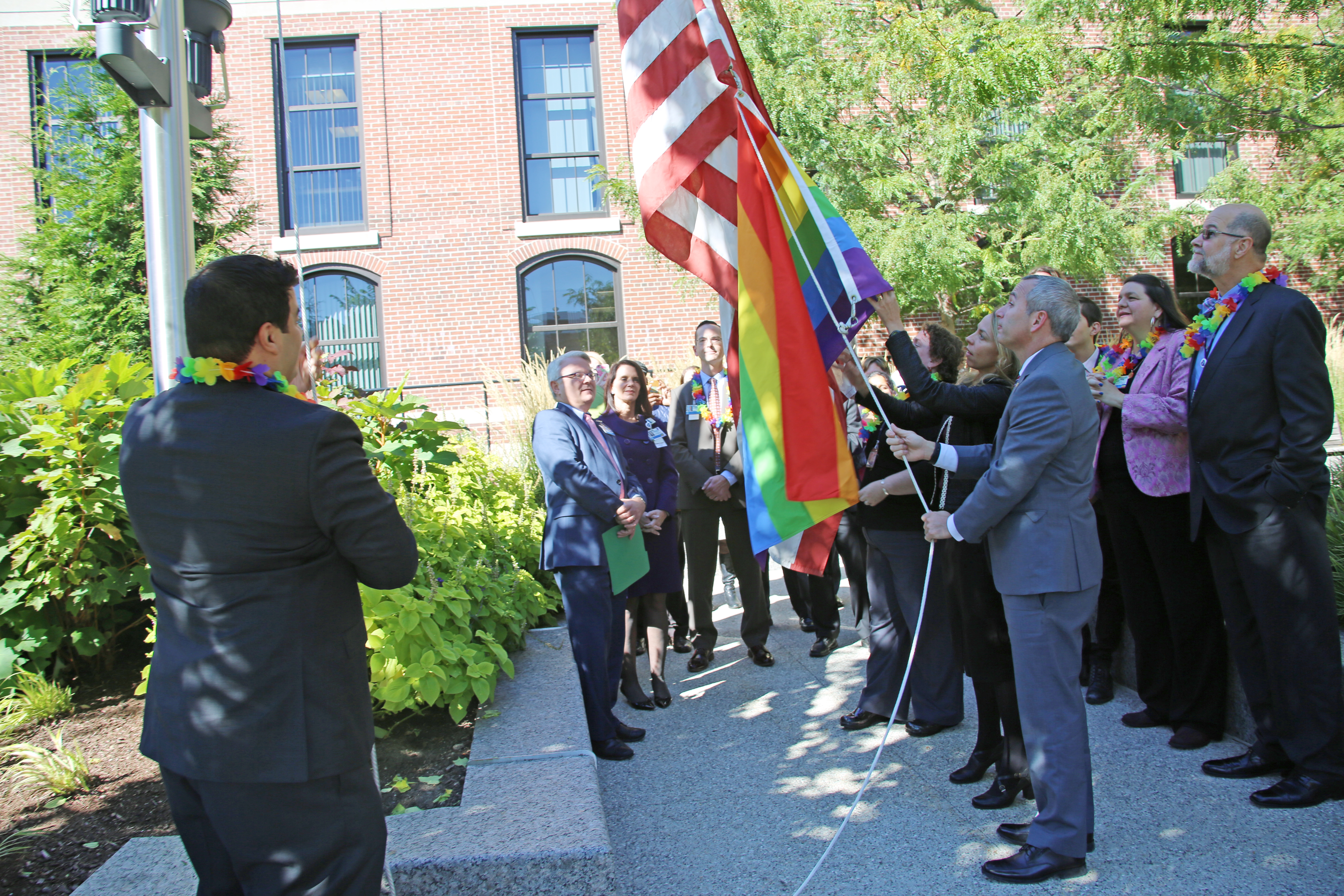
Members of the BWHC LGBT & Allies Employee Resource Group help raise a rainbow flag outside 15 Francis St.
On Oct. 11, BWHers came together for the Brigham’s second annual National Coming Out Day celebration.
The day, hosted by the BWHC LGBT & Allies Employee Resource Group (ERG), began outside 15 Francis St., where Brigham and Women’s Faulkner Hospital President Michael Gustafson, MD, MBA, and others in attendance witnessed the raising of the rainbow flag. The ceremony concluded with a rendition of Cyndi Lauper’s “True Colors,” sung by Mark Anderson, of the Department of Medicine. At the flag-raising, Gustafson emphasized that “coming out still matters.”
“When people know someone who is LGBTQ, they are far more likely to support equality under the law,” Gustafson said. “Beyond that, our stories can be powerful support for each other. We thank each of you for helping to make BWHC an inclusive and welcoming environment for all of our LGBT staff, patients and families.”
National Coming Out Day, founded in 1988, honors all who have come out as LGBT or as a straight ally for equality.
Celebrations continued with a special event in Bornstein Amphitheater, featuring Massachusetts Attorney General Maura Healey as the keynote speaker. The talk was also live streamed via webcast at BWH and BWFH.
BWHC President Betsy Nabel, MD, who introduced Healey, said it was inspiring to see the Brigham community come together to celebrate and support each other on National Coming Out Day.
“The Brigham is committed to being a welcoming place for our patients, families and staff,” Nabel said. “It’s very important to me that we treat everyone who walks through our doors with dignity and respect. That’s our Brigham Way.”
Healey, a leader and advocate on behalf of the LGBT community, said even though there has been so much progress in terms of LGBT rights, current events show there is much more that still needs to be done.
“Support is essential to helping the LGBT community feel comfortable to be who they are,” Healey said. “Our partnership with the Brigham is critical to our efforts to ensure that everyone is treated equally.”
Pothik Chatterjee, MBA, director of Business Development and Strategic Planning in the BWPO and chair of the BWHC LGBT & Allies ERG, said holding these events at BWH is important for many reasons.
“Visibility of the LGBT community matters a great deal in health care and hospitals because it allows our clinicians to provide high-quality care to all our patients. Our LGBT staff can be their authentic selves without unnecessary anxieties holding them back,” he said. “We have made an astonishing amount of progress for gay, lesbian and bisexual members of our community, and this day is a great reminder of the work that we have ahead to promote equality for our transgender community.”
National Coming Out Day at BWH, Oct. 11
The BWHC LGBT & Allies Employee Resource Group (ERG) is hosting several events to celebrate National Coming Out Day. Join BWFH President Michael Gustafson, MD, MBA, and fellow BWHers for a flag-raising ceremony at the 15 Francis St. flagpole at 11:30 a.m. At noon, Massachusetts Attorney General Maura Healey will deliver the keynote address in Bornstein Amphitheater. The inaugural BWHC LGBT Leadership Awards will also be unveiled. For more information, visit BWHPikeNotes.org.
Voting for BRIght Futures Prize, Stepping Strong Innovator Award
Two compelling competitions to advance innovation—the BRIght Futures Prize and Stepping Strong Innovator Awards—are currently underway at BWH, and voters from the Brigham and beyond will determine the winners. Both competitions feature inventive ideas from across the hospital community, and each competition’s winner will receive a $100,000 prize. Read the Q&As, view videos about the projects and learn how to vote at BWHBulletin.org. The BRIght Futures Prize will be presented at Discover Brigham on Thursday, Nov. 10. The winner of the Stepping Strong Innovator Awards public vote will be announced online on Monday, Oct. 17.
BWH’s newly renovated Garden Cafe opens Monday, Oct. 17.
The cafe, formerly known as the BWH Cafeteria, features several updates, including new and enhanced menu offerings, additional seating and more natural light.
“It’s thrilling to see the renovation project wrap up,” said Susan Langill, RD, LDN, BWHC Food Services director. “I can’t wait to see the smiles on people’s faces when they visit the cafe for the first time in just a couple of weeks.”
The cafe has been closed for renovations since March. The goal for the space, says Peter Lamb, director of BWH Food Services, is to reflect the hospital’s mission of overall health and well-being.
“The Garden Cafe is a place where people will want to visit and stay for a while,” he said. “Spaces such as this one are tremendously important for the well-being of our staff, patients and visitors.”
Inside the Garden Cafe, guests will be surrounded by natural light and full-radius views of the outdoors.
An expansive menu will feature local produce and dairy products, in addition to new options at an exhibition station, a stone hearth pizza oven, rotisserie, a Red Mango counter with smoothies and juices, an infused water station and more. The cafe also boasts an expanded salad bar and updated deli, grill and hot food stations.
Feedback from guest surveys was top of mind when designing the new space, Langill said.
“This entire cafe was renovated with our guests in mind,” Langill said. “The new cafe is going to be a fabulous space for all who visit.”
Steve Dempsey, BWH director of Planning and Construction, is proud of all the teams who worked together to make the renovation project a success.
“This is a spectacular and transformational space,” Dempsey said. “We’ve made several great design decisions that people will appreciate for years to come.”
Learn more about the opening of the Garden Cafe and other important Food Services updates.
Partnership Grand Rounds, Oct. 6
Gene Bukhman, MD, PhD, associate physician in the BWH Division of Global Health Equity and the Cardiovascular Division, will speak about “Reframing NCDs and Injuries from the Poorest Billion.” Thursday, Oct. 6, 9–10 a.m., in Carrie Hall. A live webcast will be available, starting at 9 a.m. Visit BWHPikeNotes.org for more information.
2016 Staff Influenza Vaccination Program
Flu clinics will take place around the hospital and at many off-site locations, including ambulatory clinics and research buildings, this week and throughout October. OHS will also hold walk-in hours and appointments at the Neville Building, starting Monday, Oct. 3. For a full list of staff flu clinic dates and more information about our flu vaccination policy, visit BWHPikeNotes.org.
Sex Trafficking—One Survivor’s Story, Oct. 7
In honor of Interpersonal Violence Awareness Month, Jasmine Grace Marino, a survivor leader in the anti-trafficking movement, will speak about her experience as a survivor of sexual exploitation and advocacy work. Friday, Oct. 7, 11:30 a.m.–1 p.m., in Bornstein Amphitheater.
BWH Stepping Strong Boston Marathon Team
Join the 2017 BWH Stepping Strong Boston Marathon Team and run to improve outcomes for civilians, military personnel and families recovering from traumatic injuries and events. The application period is now open. Click here for more information.
Annual Service of Remembrance, Oct. 23
Hosted by the BWH Center for Women and Newborns and CWN Bereavement Committee, this service supports families and staff who have experienced the loss of a baby during or after pregnancy and honors the babies who have passed away. Sunday, Oct. 23, in Cabot Atrium, with registration from 1:30–2 p.m., and the service at 2 p.m. Reception with light refreshments to follow. Free parking is available at 45 Francis St. Email lmorette@partners.org with questions.

Ashley Brent, of BWH Telecommunications, reads a scripted announcement over the building’s loudspeaker.
To rehearse and evaluate the hospital’s response plan to a life-threatening situation, approximately 70 BWH staffers participated in an active shooter exercise in the new building, now named the Building for Transformative Medicine, at 60 Fenwood Road on Sept. 21.
Volunteer participants met on the third floor of the new building at 9 a.m. to review safety protocols. Several members of the Boston Police Department and Boston Emergency Medical Services also joined to simulate their response to an active shooter event. The exercise was confined to the second and third floors of the building, and all BWH participants wore colored vests indicating their role.
Organizers say the fact that the new building remained mostly empty—patients won’t be seen there until Oct. 3—allowed them to run the exercise without disrupting the hospital’s normal operations.
“This was an important opportunity for us to continue to improve our preparation, response and recovery in the rare event we are faced with an active shooter situation,” said Eric Goralnick, MD, MS, medical director of Emergency Preparedness at BWH. “Various members of our Brigham team who participated—ranging from nurses, physicians, social workers, Employee Assistance Program staff and administrators, along with Boston EMS and Boston Police—helped simulate a realistic environment, which provided a great learning experience for all involved.”
The exercise lasted about 20 minutes, beginning with an air horn sound to signal the first “gunshot.” No actual weapons, ammunitions or simunitions (also known as blanks) were used at any time.
Two role-player volunteers dialed the code line to notify an operator at BWH Operator Services, who was also part of the exercise, that a shooter was in the building. All communications during the exercise started and ended with role-players stating this was a drill.
Within minutes of the initial calls, a volunteer from BWH Operator Services announced over the building’s loudspeaker that there was a life-threatening situation in the building and all people should immediately move away, if it was safe to do so, or shelter in place. Shortly afterward, Boston Police moved into position to simulate their response—locating and apprehending the shooter, who was role-played by an actor. Once police deemed it safe for EMS to approach the scene, first responders identified and triaged victims, who were role-played by a mix of BWH staffers and mannequins.
An incident command response was also simulated, where representatives from Psychiatry, the Employee Assistance Program, Social Work, Occupational Health Services and Patient/Family Relations focused on improving and implementing the hospital’s psychological first-aid response plan.
Being able to practice and evaluate BWH’s active shooter plan in a real-world environment—including the opportunity for staff to simulate a run-or-hide response—will be invaluable to everyone who participated, said Robert Chicarello, director of BWH Security and Parking.
“This was a wonderful example of interagency collaboration between the Brigham, Boston Police and Boston EMS, as well as our volunteers and role-players,” Chicarello said. “Although our sincere hope is that this training never becomes necessary for anyone to use, being able to practice it makes us all safer. What our participants learned here can work anywhere.”
The event concluded with debriefings in the new building, where participants shared their reactions to the drill and identified potential areas for improvement.
“It was a great opportunity for our staff to practice running or hiding from a life-threatening situation,” said Michael Rourke, Emergency Preparedness program manager at BWH and BWFH. “Boston Police and EMS were also thankful for the opportunity to practice their response to an active shooter in an unfamiliar environment.”

Rajesh Patel, MD, demonstrates his use of Dragon Medical 360.
Since February, the BWHC Dragon team has taught more than 800 providers how to train their Dragon—that is, how to use the voice-recognition software Dragon Medical 360.
The application replaces traditional dictation and provides an efficient alternative to typing—empowering providers to deliver more accurate documentation without disrupting workflows. The result: a more efficient, improved experience with Epic, which ultimately allows providers to spend more time with patients.
Dragon can automate Epic workflows, such as SmartPhrases, orders, launching clinical reference tools and other applications (e.g., paging). Benefits to using Dragon include reduced documentation burden, improved dictation efficiency and a decrease in documentation turnaround time. By teaming up with Nuance’s certified Dragon trainers, the BWHC Dragon team has been able to offer personalized on-site training and elbow-to-elbow support.
BWH clinicians such as Matthew Kim, MD, of the Division of Endocrinology, Diabetes and Hypertension, described the transition from phone dictation to Dragon voice recognition as positive and seamless.
“Most of the providers in our division who’ve adopted it have found that they’re able to complete dictations with high degrees of accuracy and minimal need for editing and correction,” Kim said. “The integration of voice-activated order sets may also help to increase our overall efficiency and productivity. We’re hoping that, over time, the advantages offered by this system will encourage more of our trainees to take on the challenge of learning to dictate in practice.”
By using Dragon, providers are able to dictate at their desks, in the clinics and soon in the operating rooms. The freedom to dictate whenever and wherever, across multiple platforms (including Epic, Microsoft Office suite and PowerPath), attributes to the program’s continued success and expansion.
Dragon training will continue through the remainder of 2016 with Nuance-certified trainers. The BWHC Partners eCare team will take over Dragon training in January 2017. All providers who complete classroom training and personalization will receive a free headset. Attending physicians are also eligible this year for a free PowerMic III.
To learn more about using Dragon Medical 360 at BWH, visit the BWPO intranet. For more information or to submit questions, email BWHCdragon@partners.org.
HealthStream Mandatory Courses Deadline, Sept. 30
BWH requires all employees to comply with mandatory education requirements as related to job role. The 2016 Annual Mandatory Education courses must be completed by Friday, Sept. 30. Content can be accessed at Partners Applications > Utilities > HealthStream. Visit BWHPikeNotes.org for more information.
Vote Today: Shape the Future of Innovation
Two competitions to advance innovation—the BRIght Futures Prize and Stepping Strong Innovator Awards—are underway at BWH, and voters from the Brigham and beyond will determine the winners. Read the Q&As, view videos about the projects and learn how to vote here. The BRIght Futures Prize will be presented at Discover Brigham on Thursday, Nov. 10. The Stepping Strong Innovator Awards winner will be announced online on Monday, Oct. 17.
Join Team BWH in the Tour de South Shore
Join Team BWH in the Tour de South Shore on Saturday, Oct. 1. Participants can bike 25 or 50 miles or walk 3.1 miles to raise funds that will support the Ann Romney Center for Neurologic Diseases at BWH. Help us accelerate the prevention, treatments and cures for five of the world’s most complex neurologic diseases: multiple sclerosis, Alzheimer’s disease, ALS (Lou Gehrig’s disease), Parkinson’s disease and brain tumors. Visit crowdrise.com/BWHTourdeSouthShore2016 for more information and to register. Email KKilkelly@partners.org for more information.
BWH vs. BWFH Fall Activity Challenge
BWH and BWFH are partnering with Blue Cross Blue Shield in a friendly competition to see which hospital’s team has a more active workforce. For more information or to join the BWH team, email mdashi@partners.org.
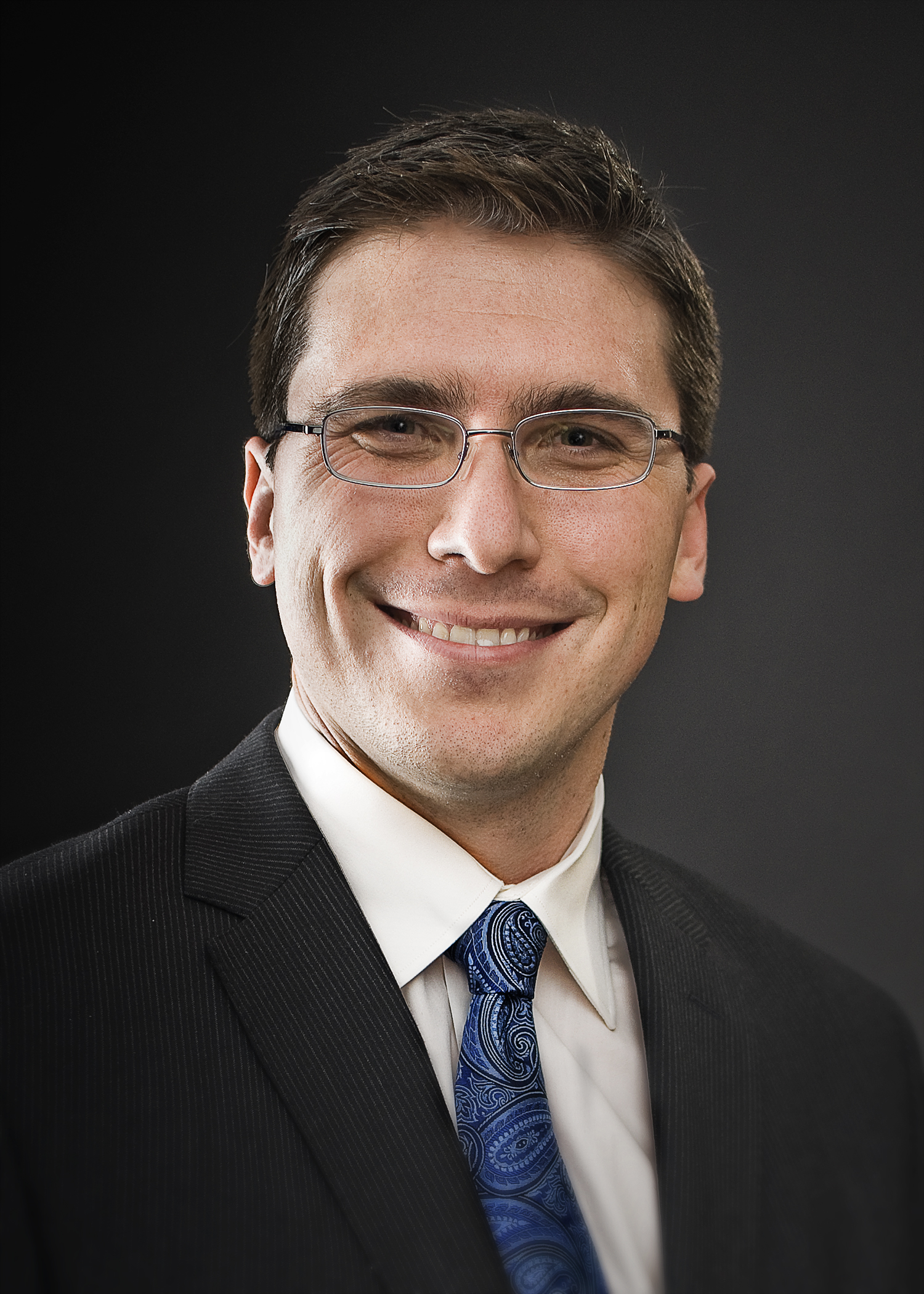
Michael J. Weaver, MD
What challenge does your project address?
Fractures are an extremely common result of trauma—whether they result from a car accident, an injury on the battlefield or a bad fall. While huge advances have been made in the surgical treatment of fractures, there are currently no medications available to help speed bone healing. The primary reason for this deficit is that, based on current technology, it is challenging to accurately measure bone healing, which makes drug trials exceedingly difficult to perform.
The goal of our project is to develop a reliable method of accurately measuring bone healing. This will enable us to collaborate with pharmaceutical companies to develop medications to improve and accelerate the often lengthy bone healing process.
What is a compelling aspect of your project?
Our project involves combining our understanding of bone healing with advances in CT scan technology that will allow us to measure microscopic changes in bone. We will develop a tool that allows us to measure how much motion occurs between the bone ends at a fracture site, such as a wrist fracture, during the healing process. The device will apply a small load, at a level that produces minimal discomfort, to the broken bone. A high-resolution CT scan will then be used to measure how much motion occurs. Knowing that fractures become stiffer as the healing process progresses, the device will measure the bone knitting together, with less motion over time.
This combination of technologies will allow us to more precisely measure bone healing than previously possible, as well as help to spur the development of medications that can expedite it.
How will your project benefit future patients who suffer from trauma-related injuries?
Over 7 million people break a bone every year. While there are numerous drugs to treat other common medical problems like high blood pressure or asthma, there are no medications to help heal broken bones. The goal of this project is to develop a tool to better measure bone healing, thus spurring drug development companies to discover medications that will both improve the speed of recovery and decrease the challenge of healing problems. Anyone who has had a broken bone, or knows someone who has, knows how difficult the recovery process is. Innovations such as the one we are proposing that speed the healing process will result in less pain, a quicker recovery and the hope that patients can quickly resume their everyday routines.
CAST YOUR VOTE
or read more about the other Stepping Strong Innovator Awards finalists:
 Detecting Early Neurological Decline Detecting Early Neurological Declineto Prevent Paralysis |
 Stimulating Muscles to Stimulating Muscles toAccelerate Rehabilitation |

Giorgio Giatsidis, MD
What challenge does your project address?
Injuries to the legs and arms often destroy muscle, reducing both mass and strength. Today, there are almost no approved therapies or strategies—for use in conjunction with standard physical therapy—to induce muscle regeneration or accelerate recovery following trauma. Unfortunately, current interventions remain rudimentary, and prolonged hospitalization incurs further tissue damage.
Once home, trauma patients face a steep path of rehabilitation. I call this “the trauma iceberg.” That is, what we see—and treat—is only the tip of what our patients actually experience. This project aims to break the trauma iceberg by developing novel therapies to initiate muscle recovery immediately following the trauma, prevent the onset of further inactivity-induced damage and accelerate the rehabilitation path toward a normal life.
What is a compelling aspect of your project?
Our cells regenerate in response to mechanical stimulation. For example, when we go to the gym, we stimulate muscles by stretching and contracting them, and this activity makes them grow. These principles can also be used to design novel, safe, non-invasive and patient-friendly therapies.
This project seeks to address the burden of prolonged trauma rehabilitation by passively stimulating injured muscles to regenerate and accelerate their recovery directly at the bedside. To realize our goals, our team will determine the exact conditions to effectively promote mechanically induced regeneration of injured muscle and, in collaboration with engineers, integrate these findings into the development of a portable device that can be easily applied to trauma patients inside the hospital and at home.
How will your project benefit future patients who suffer from trauma-related injuries?
Traumatic muscle injuries to legs and arms are a very common and dramatic occurrence. Trauma care for these patients does not end with the treatment of acute, life-threatening conditions and wounds. It continues through the long, challenging path of rehabilitation.
Our proposed therapy and device will help to facilitate muscle regeneration in a hospital setting, prevent the onset of further damage and accelerate the path of rehabilitation.
CAST YOUR VOTE
or read more about the other Stepping Strong Innovator Awards finalists:
 21st Century Tools to Measure 21st Century Tools to Measurethe Progress of Bone Healing |
Detecting Early Neurological Decline to Prevent Paralysis |

Giovanni Traverso, MD, PhD
What problem are you trying to solve and why?
Ulcerative colitis is a lifelong, debilitating disease that causes severe inflammation of the gastrointestinal tract—specifically, the colon. It affects almost 800,000 people in the U.S., with an additional 60,000 new cases diagnosed every year. Symptoms include abdominal pain, rectal bleeding and chronic diarrhea. More than 20 percent of patients eventually undergo surgery to remove part or all of the colon. The disease also carries a social stigma and can significantly diminish quality of life. Better treatment options are urgently needed.
Today, patients are often prescribed medicated enemas that require them to retain the medication overnight to maximize its absorption in the colon. It is an uncomfortable experience that a patient may have to endure nightly for weeks. While some drugs are highly effective at quelling the inflammation that causes UC’s symptoms, they are too large and delicate to be delivered directly into the colon. They must be injected, which has many drawbacks.
What is your solution?
We have developed a device that uses ultrasound to deliver therapies directly to the site of disease with a brief enema, stopping inflammation without the need for an injection or overnight enema. Patients can use this device themselves in their homes, enabling them to take back control and live happier, healthier lives.
By using ultrasound to gently propel medication into the tissue, significantly greater amounts of the drugs can be delivered. And it only takes one minute—as opposed to several hours—for this device to administer medication. We also anticipate that we will be able to use our method to deliver a wide variety of drugs and new treatments as they become available—not just for treating ulcerative colitis, but also for other diseases.
How will your research project benefit people?
This device will be easier and more convenient for patients to use, with better clinical outcomes for those who suffer from ulcerative colitis. Not only will our device reduce the burden of enema administration, but it will also enable patients to receive highly effective medications that currently may only be injected. This will reduce patients’ medical expenses, improve their outcomes and prevent the worsening of symptoms or the development of related diseases. Finally, the technology this device runs on has the potential to be used in treating a wide range of other diseases, and due to its simplicity, our device can be used continuously for days, like an IV infusion. Many apheresis treatments for hospitalized patients are staggered three times a week because of the staffing complexity and large blood volumes involved. With this device, patients won’t have to wait between treatments, and we can remove more disease-causing antibodies and blood cells than is currently feasible.
CAST YOUR VOTE
or read more about the other BRIght Futures finalists:
 Predicting Alzheimer’s Predicting Alzheimer’s |
Active Shooter Exercise at 60 Fenwood Road
An active shooter exercise will take place in the new building at 60 Fenwood Road on Wednesday, Sept. 21, at 10 a.m. The exercise will enable BWH Security and Emergency Management, in coordination with Boston Police and Boston Emergency Medical Services, to practice and evaluate the hospital’s response plan to a life-threatening situation. During the exercise, signs will be placed around the hospital and the building to indicate the exercise is taking place. No other areas of the Brigham will be involved. To reduce concerns, please note that an air horn sound will be used in the new building during the exercise. Staff may contact the Employee Assistance Program at 617-732-6017 or BWH Security at 617-732-6565 with questions or concerns.
Join the 2017 BWH Boston Marathon Team
Calling all runners! Join the 2017 BWH Stepping Strong Boston Marathon Team and run to improve outcomes for civilians, military personnel and families recovering from traumatic injuries and events. The application period is now open. Learn more here.
September Is National Preparedness Month
This year’s theme is “Don’t Wait. Communicate. Make Your Emergency Plan Today.” BWHC Emergency Management will be holding public information sessions throughout the month: Friday, Sept. 23, 11 a.m.–1 p.m., and Thursday, Sept. 29, 2–4 p.m., in Cabot Atrium. Visit BWHPikeNotes.org for more information.
National Coming Out Day at BWH, Oct. 11
Celebrate National Coming Out Day at BWH. The BWHC LGBT & Allies Employee Resource Group (ERG) is hosting a special event on LGBT health, featuring Massachusetts Attorney General Maura Healey as the keynote speaker. BWHC President Betsy Nabel, MD, and BWFH President Michael Gustafson, MD, MBA, will be in attendance. The inaugural BWHC LGBT Leadership Awards will also be unveiled. Tuesday, Oct. 11, noon–1 p.m., in Bornstein Amphitheater. Learn more at BWHPikeNotes.org.

Thomas Walsh, of BWHC Analytics, Planning and Process Improvement, speaks at the Lean presentations in July.
For Dorothy Goulart, MS, RN, director of Process Improvement for BWHC Analytics, Planning and Process Improvement (APPI), it’s always gratifying to see positive reactions of clinicians, staff and managers when they complete the Lean Practitioner Program.
The program, offered by APPI, teaches leaders how to engage staff in process improvement within a department, practice or unit. The training lasts four months, culminating in participants applying what they learn in the classroom to real-life improvement projects at BWH and Brigham and Women’s Faulker Hospital.
“Through Lean improvement projects, training and coaching, our BWHC Process Improvement team has touched nearly every department, inpatient unit, ambulatory practice and community health center,” said Goulart, who retires this month. “Lean is about continual learning on how to help people see and understand the causes of process problems and to work together with colleagues to solve them.”
Staff members from Process Improvement serve as team coaches. More than 300 BWHers have participated in Lean since 2008.
“The Lean Practitioner Program trains you to look in places you might not think would make your work more efficient,” said Steven Bloom, MSc, director of Environmental Affairs, who participated in one of the program’s two sessions this year with colleagues from BWH Facilities and Operations. “Small changes in sequences, positioning or timing can yield noticeable improvements.”
Past Lean projects have included improving the discharge time for patients, streamlining billing processes, improving the Occupational Health Services clearance process for new hires and providing a safer, more efficient way to administer IV medications.
Tools for Today and Tomorrow
In June, nine teams of directors and managers from Facilities and Operations presented Lean projects they had proposed and implemented during the four-month course. Projects ranged from decreasing the time it takes to valet a car at BWH to improving times for patient tray assembly for room service.
John Pierro, senior vice president of Facilities and Operations, wanted his staff to participate in Lean because he knows its benefits firsthand.
“I was trained in Lean 15 years ago and I’ve carried the knowledge with me in all of my positions since then,” he said. “The ability to figure out workflow and to get through a day without wasting precious resources allows us to focus more time on the patient care experience. Lean, from a manager’s perspective, gives staff a series of tools and techniques to become more efficient and effective.”
Paula Barry, director of Materials Management, and Therese Breen, a Materials Management manager, worked together to improve the process of making sure slings are ready for patients who need them. They said the program provided them with the tools to put process improvements in place based on facts instead of assumptions.
Pierro said the beauty of Lean training is that the concepts are implemented as groups move through the program. He stressed that projects that go through Lean are not completed and then forgotten.
“The have a real impact,” Pierro said. “The projects are done on a scalable, pilot basis, and when there is success and sustainability, they are immediately pushed out to the rest of the hospital.”
Patrick Hubbard, operations manager of BWH Patient Dining Services, agreed that the benefits of being trained in Lean principles are long-lasting. Hubbard and colleagues from BWH Food Services received Lean training earlier this year.
“They give you fresh eyes to look at how your workflow can run at peak performance,” he said. “The Lean program was a great experience and provided me with tools I can use now and in the future.”
John Rossi, MBA, of Process Improvement, guided the teams. He said it was exciting to see how each team worked to define and diagnose a problem and then figure out how to implement changes and solutions.
“Facilities and Operations is well on its way to fostering a culture of continual improvement,” Rossi said. “I’m excited to hear updates from the teams as the projects continue to advance.”
Approximately 2,500 BWH staffers celebrated the upcoming opening of the new building at 60 Fenwood Road with sweet treats and giveaways at an afternoon ice cream social and evening table event on Sept. 8.
Clinical Systems Audit Begins Sept. 12
The annual BWH Clinical Systems Audit begins Monday, Sept. 12. The audit aims to ensure that all BWH employees use no more than the minimum necessary patient information to perform their duties. The audit period runs for three weeks, ending Friday, Sept. 30. During this time, the BWH Privacy Office will be available to assist managers with completing audits. Call 617-582-5201 or email
PHSClinicalSystemsAudit@partners.org with questions.
Free LGBT Health Care Webinars
Help BWH earn recognition as a leader in LGBT Health Care Equality by viewing a webinar from the National LGBT Education Center about patient-centered care for LGBT patients. Understanding and respecting the diverse perspectives, needs and concerns of our patients are vital to providing the highest-quality care. The deadline to view the webinar and complete the training is Friday, Sept. 30. Visit BWHPikeNotes.org to learn more.
Have You Lost 10 Pounds in the Past 1.5 Years?
Jason Block, MD, of BWH’s Department of Medicine and the Harvard Pilgrim Health Care Institute, is conducting a research study that uses financial incentives to encourage employees who have lost at least 10 pounds in the past 1.5 years to keep the lost weight off. Participants will complete two brief surveys and weekly weigh-ins for one year at several locations on the BWH campus. If you’d like to participate or learn more, contact research assistant Michael Seward at 617-867-4419 or email BWHealth@harvardpilgrim.org.
Save the Date: Discover Brigham 2016
Discover Brigham brings together our community with the broader Boston health care ecosystem to educate and inspire collaboration around innovative science, technology and medicine. The theme of this year’s Discover Brigham is “Collaborate, Translate and Accelerate” as a reflection of similar goals for the new building at 60 Fenwood Road. Thursday, Nov. 10, noon–6 p.m.
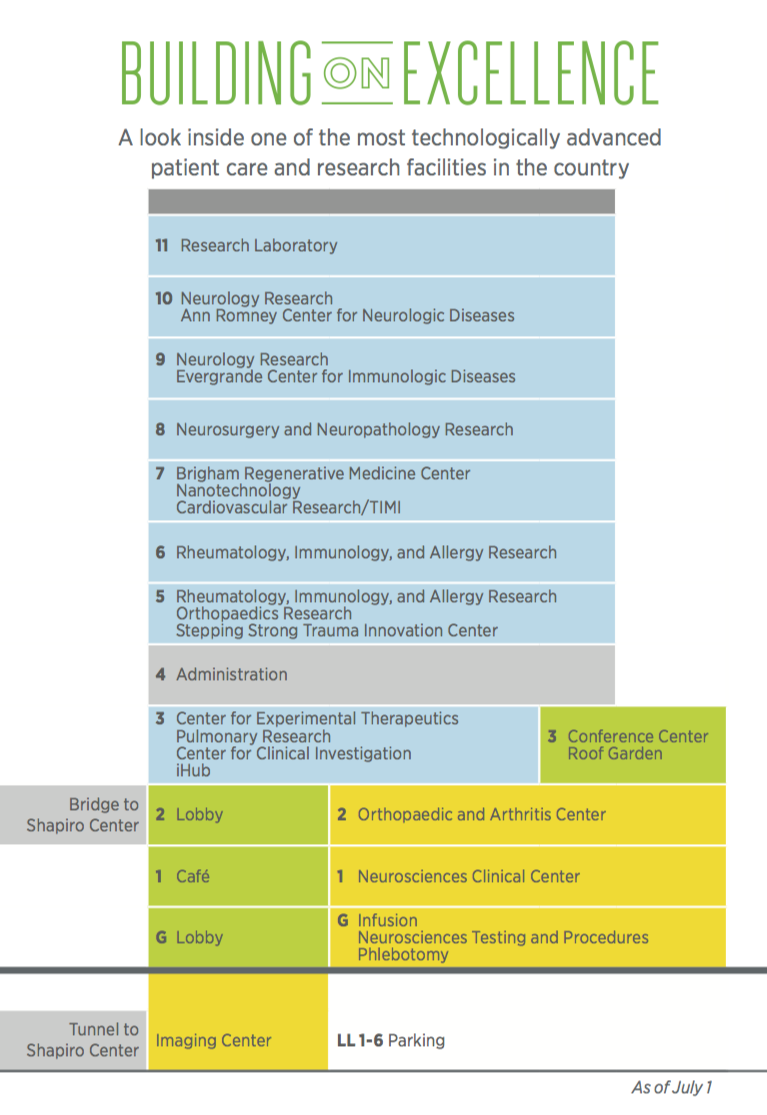
What goes into building one of the most technologically sophisticated research and patient care facilities in the country?
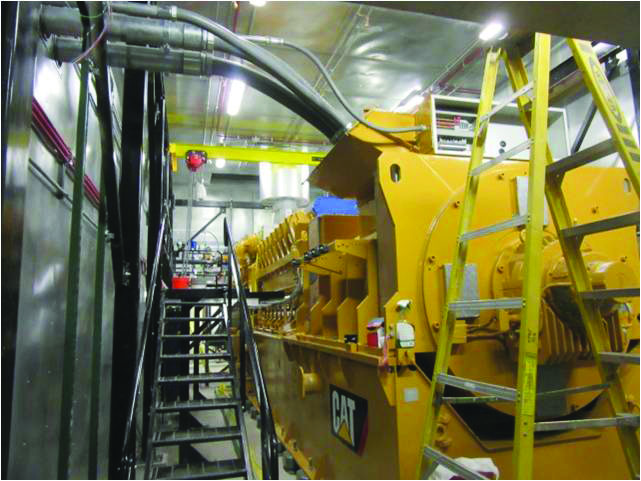
The 16-cyclinder engine powering the cogeneration plant
Green isn’t just part of the color scheme at 60 Fenwood Road.
Energy efficiency and environmental sustainability have been cornerstones of the building’s design since its early stages, with numerous creative features contributing to its eco-friendly footprint, according to Steve Dempsey, BWH director of Planning and Construction. The building’s green design, construction and maintenance practices conform to the U.S. Green Building Council’s LEED Gold standards, making it the highest-rated LEED structure at the Brigham once certified.
One of the standout features of the new building is a subterranean cogeneration plant, built in Germany, enabling the hospital to produce its own heating, cooling and electricity for the first time. Cogeneration, sometimes referred to as combined heat and power, is an energy-efficient technique for producing electricity and heat simultaneously.
Powered by natural gas, the plant’s 16-cylinder engine will produce enough energy to meet 80 percent of the electricity demands of both the new building and the Shapiro building, Dempsey explained. The dramatic cost savings associated with producing energy in-house will enable the hospital to recoup its investment in the plant’s infrastructure in a mere six years.
“We all have to find effective ways to reduce our operating costs, and the clever design of this state-of-the-art building is going to save the hospital a lot of money, which will help increase our margin,” Dempsey said.
Currently, the Brigham obtains most of its energy from the Medical Area Total Energy Plant, better known by its acronym MATEP, a private power plant serving the Longwood Medical Area. The cost of producing energy in the new cogeneration plant will be lower than MATEP’s rates, and having the physical plant in such close proximity allows BWH to get more bang for its buck, Dempsey said.
“When a utility company supplies power to you through its transmission wires, the electricity loses a bit of its ‘punch’ as the distance of that transmission increases,” he said. “By becoming a source for our own electricity, it allows us to have so much more energy efficiency.”
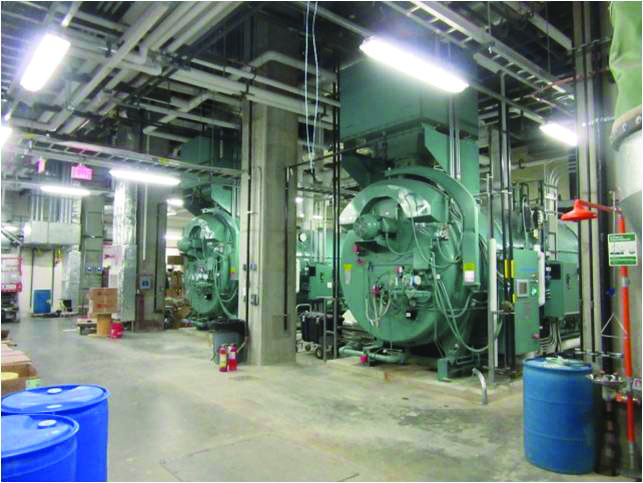
Boilers inside the cogeneration plant
The cogeneration plant is one of many green features at the new building. Other design elements to reduce energy consumption include extensive use of natural lighting, as well as sensors that only turn on the lights if a room is occupied. Innovative façade-shading devices—the green, yellow and gray paneling that run vertically along the building’s exterior—will help reduce glare and cooling costs. Meanwhile, green and white roof surfaces insulate the building from a heat-island effect common in urban areas.
Behind ceiling panels inside the building are chilled beams—metallic beams containing chilled water that cool a room when air passes over them. Water retains its cooling properties better than air does, Dempsey said, making the design far more efficient than traditional commercial ducted cooling. The beams are expected to reduce energy needs by 20 percent.
Water plays a starring role in other sustainability features in the building. A 40,000-gallon cistern will catch rainwater for reuse in mechanical systems. In addition, all large roof surfaces are blanketed with plants that can absorb rain, ultimately reducing runoff and the burden it puts on Boston’s wastewater treatment system.
“As we consider our future mid-campus redesign, cogeneration and all of these other techniques we’ve adopted in the new building will be revisited,” Dempsey said. “We’ve identified the path forward for us to make enormous savings in utilities and to create environments our staff is going to love.”

This outdoor sculpture is one of the building’s three signature pieces of artwork.
Adding to the new building’s contemporary feel will be paintings, sculptures and other installations that offer artistic interpretations of the scientific breakthroughs happening inside, as well as the sense of caring and compassion patients will feel there.
The hospital has acquired approximately 40 pieces of original artwork for the new building, according to Kathleen Hughes, assistant vice president of Donor Relations in BWH Development. Those include three signature pieces: a large outdoor sculpture, a prominent painting in the first-floor atrium and an encaustic (wax-based) piece to be installed in the ground-level lobby. The third item is on a long-term loan from the Karsh Center at the Museum of Fine Arts, through a partnership with philanthropist Estrellita Karsh.
The remaining artwork will consist of smaller pieces in patient exam rooms, infusion rooms, waiting areas and hallways throughout the building.
In addition, several architectural features contribute to the building’s aesthetic, including the glass staircase in the main lobby—a blue and green interpretation of humans’ genetic code. On the walls of the clinical floors will be colorful panels with imagery representing the various specialties, such as creative displays of neurons in the Neurosciences Center.
PIE Awards: Nominate Your Colleagues
The Partners in Excellence awards program recognizes our star performers—those whose efforts have gone above and beyond over the past year to ensure patients, families and staff feel welcomed and cared for. Team nominations should consist of 25 or fewer people. The deadline for submitting nominations is Friday, Sept. 16. The date of the award ceremony is forthcoming. Visit BWHPikeNotes.org for more information and to complete a nomination form.
LGBT Health Care Webinars, View by Sept. 30
Help BWH earn recognition as a leader in LGBT Health Care Equality by viewing a free webinar from the National LGBT Education Center about patient-centered care for LGBT patients. Understanding and respecting the diverse perspectives, needs and concerns of our patients are vital to providing the highest-quality care. The deadline to view the webinar and complete the training is Friday, Sept. 30. Visit BWHPikeNotes.org for more information.
Women in Medicine and Science Symposium
The fifth annual Women in Medicine and Science Symposium highlights the achievements of female faculty and trainees at Brigham and Women’s Health Care. The program focuses on collaborations across various disciplines, including basic, clinical and translational research, as well as clinical innovation and medical innovation, with the goal of building community. BWHC President Betsy Nabel, MD, will present this year’s keynote address. Monday, Sept. 26, 3–6 p.m., in Bornstein Amphitheater and the rotunda at 15 Francis St. Visit BWHPikeNotes.org to learn more and register.
Medical Library Fall Courses
The BWH Medical Library is offering courses this fall to help hospital employees take advantage of the library’s resources. Classes include “My NCBI—How to Use the PubMed Tool,” “Images—How to Locate Images for Presentations,” “Advanced Google Searching,” “How to Use RefWorks” and “PubMed Searching.” Classes take place at the Medical Library, TH-127. Space is limited. Visit BWHPikeNotes.org to learn more and register.
Mark your calendars! The next issue of BWH Bulletin, on stands and online Sept. 6, will be devoted to BWH’s newest building at 60 Fenwood Road. Learn more about how the building will benefit patients, what eco-friendly features make it stand out and where you can celebrate the big opening. Also, check out a special issue of BWH Clinical & Research News featuring stories from the Building on Excellence series at BWHClinicalandResearchNews.org.
What excites you most about the new building? Email your answer to BWHBulletin@partners.org by Aug. 30 and your response may be featured in the next edition of Bulletin.
Staff Ice Cream Social: To celebrate the upcoming opening of the new building, staff are invited to an ice cream social. The social will include ice cream and giveaways. Sept. 8, 2:30–5:30 p.m., on the ground level of the new building. Visit BWHPikeNotes.org to learn more.
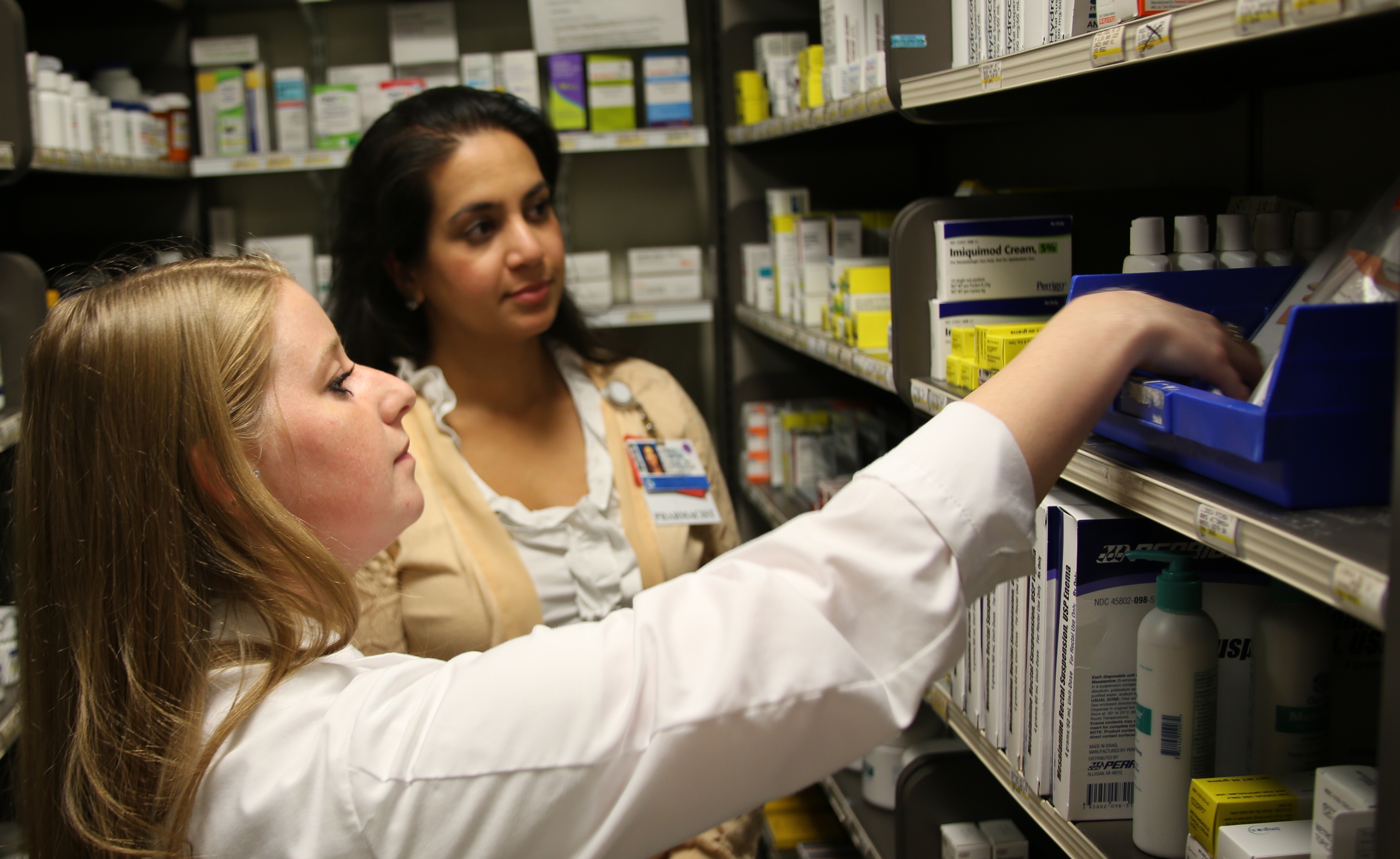
From left: Pharmacists Jayme Boutilier and Amrita Chabria review naxolone inventory in the Outpatient Pharmacy.
Scott Weiner, MD, MPH, began to notice two trends emerge over the past decade in emergency departments around Boston: The number of opioid prescriptions was increasing and, more troubling, so was the frequency of patients who had overdosed on prescribed or illegally obtained opioids.
“It got to the point that on nearly every shift I was working, someone would come in with an overdose. It started to just seem normal, which is unacceptable,” said Weiner, who joined BWH’s Department of Emergency Medicine in 2014.
The observation wasn’t merely anecdotal. Opioid addiction has escalated into a public health crisis across the state—and the country—with the Massachusetts Department of Public Health reporting an estimated 1,659 unintentional and undetermined opioid-related deaths in 2015, the highest-ever number recorded by the state.
At BWH, small projects began popping up in various departments in response to the crisis. But a comprehensive, hospital-wide approach was necessary, Weiner said. As a result, he worked with champions from various departments and disciplines across BWHC to form the Brigham Comprehensive Opioid Response and Education (B-CORE) program earlier this year.

Members of BCORE’s Addiction Task Force, from left: Kristen Wendth, Elizabeth Harry, Scott Weiner, Lina Matta, Juan Jaime de Zengotita, Erika Pabo, Stuart Pollack and Joji Suzuki
The group is made up of pain specialists, surgeons, hospitalists, nurses, primary care providers, pharmacists, Partners eCare representatives and others. Supported by an executive steering committee consisting of BWHC leadership, B-CORE members work in task forces focused on issues around opioid prescribing and treating opioid addiction.
Their goal for this year is to develop BWHC-wide guidelines for opioid addiction prevention and management, opioid prescribing and chronic pain management. Technology, data, outreach, clinical support and training all play vital roles in achieving that.
“B-CORE is an umbrella,” Weiner said. “It belongs to the whole hospital—not just a handful of departments—as a way to support all opioid-related projects.”
Responding to the crisis requires not only the development of best practices—such as standardizing opioid dosage recommendations—but also a cultural shift in how addiction is treated, says Joji Suzuki, MD, director of the BWH Division of Addiction Psychiatry and the head of B-CORE’s addiction task force.
“The reality is that most hospital systems in this country have not incorporated addiction treatment into their programs,” he said. “The opioid crisis has forced us to rethink how we bring treatment for addiction into the mainstream.”
Taking the First Steps
Since its inception earlier this year, B-CORE has implemented several initiatives. Naloxone, a fast-acting treatment for opioid overdoses, is now available to at-risk patients in the Emergency Department at no cost and without a prescription. In addition, the Outpatient Pharmacy recently launched a drug take-back program, providing a secure bin to deposit leftover pills so they can be disposed of safely.
Looking ahead, B-CORE’s members also hope to launch a “bridge clinic,” a temporary care clinic for patients who need treatment for a substance use disorder after overdose or hospitalization but cannot immediately get into a long-term program.
Technology will be pivotal for other initiatives. BWH hospitalists Elizabeth Harry, MD, and Raj Patel, MD, are working with B-CORE to implement a framework developed by the Society of Hospital Medicine called RADEO (Reducing Adverse Drug Events Related to Opioids), which provides guidelines for safer opioid prescribing and symptom management.
As part of the project, they are collaborating with BWH’s Patient Safety Learning Labs to develop a dashboard within Epic that will automatically flag an opioid prescription if the dose is too high or if another medication is needed to manage its side effects. The system also recommends that non-opioid medications are prescribed first. Additionally, Harry and Patel are working on a mobile app that allows patients to notify their providers if they have concerns regarding their pain levels or treatment.
“The more barriers we can remove to getting clinicians what they need to make these decisions, the better care we’re going to provide,” Harry said.
Meanwhile, Pharmacy is collaborating with the PeC team to provide clinicians with a high-level view of their opioid prescribing habits. The teams are meeting with prescribers to learn what data would be most helpful, such as how many prescriptions they write each month and for what doses.
Providers sometimes struggle to find time to reflect on those trends amid daily demands of the job, said BWHC Chief Pharmacy Officer William Churchill, MS, RPh, FMSHP, a member of BCORE’s steering committee. Giving prescribers that data in an easy-to-digest format can help them make more informed care decisions, he said.
“There might have been three patients with the same condition, but three different quantities of medication were given,” Churchill said. “Seeing that may be an ‘ah-ha’ moment.”
The goal is not to eliminate the use of opioids but to prevent abuse, said Jessica Dudley, MD, BWPO chief medical officer, BWHC vice president of care redesign and part of BCORE’s steering committee.
“We now have the ability to treat pain so well, and you wouldn’t want to withhold that from patients where the treatment is clearly indicated,” she said. “These interventions should enable us to continue to prescribe those medications in a more sophisticated way so that we can reduce the amount of abuse seen now.”
Security Officers Carry Naloxone
Every second counts during an overdose, and fast access to naloxone can be the difference between life and death.
Since Aug. 15, select BWH Security officers began carrying the life-saving therapy after completing training to safely administer it to someone overdosing on opioids.
Security launched the initiative with help from the Emergency Response Committee and the STRATUS Center for Medical Simulation.
“Security is usually the first on the scene during a medical emergency and we call the code, so there can be a gap between when we find the person and when the code team arrives,” said Robert Chicarello, director of BWH Security and Parking. “It became clear that if our officers carry naloxone, they may be able to save a life.”
BWHC’s Strategy in Action: Improve HealthBuilding on Excellence Tours, Ice Cream Social
In celebration of the opening of the new building at 60 Fenwood Road this fall, BWH has planned several events for staff, including an ice cream social and tours. The ice cream social will be held on Thursday, Sept. 8, 2:30–5:30 p.m., on the ground floor of the new building. Visit BWHPikeNotes.org to view a full listing of tour dates and instructions on how to sign up for tours.
Workforce Development Fall 2016 Courses, Programs
This fall, Workforce Development is offering ESOL (English for Speakers of Other Languages), Computer Basics and Citizenship courses, in addition to tuition reimbursement, academic advancement and career coaching services. All programs and courses are at no or low cost to staff. Email bwhwfd@partners.org or call 857-307-3738 for more information. For fall course enrollment, contact WFD by Friday, Aug. 26.
Join the BWH, BWFH Heart Walk Team
BWH and BWFH are participating in the upcoming American Heart Association Boston Heart Walk on Saturday, Sept. 10. If you would like to join the team, become a captain or donate, email meholmes@partners.org or visit BWHPikeNotes.org.
Food Services Menu, Alternative Dining Options
BWH Food Services now uses www.bwh.catertrax.com to update and display the weekly BWH Cafeteria menu. CaterTrax can also be used for desktop dining and catering orders. During the Cafeteria closure, the menu on CaterTrax is only offered at the pop-up location on the Tower 2 mezzanine. Visit bwh.catertrax.com to learn more. Learn more about alternative dining options available during the Cafeteria closure at BWHPikeNotes.org.
Assembly Row Complex Opens
The official move-in has begun at Partners HealthCare’s new Assembly Row complex in Somerville. The building’s new occupants include Partners employees from Finance, Human Resources, Information Systems, General Counsel and other departments. The new building will combine most staff into a single-campus setting. The facility was designed to make it easier for departments to share resources and maximize efficiency across the organization. Visit BWHPikeNotes.org to learn more.
MNA Ratifies Agreement
On July 20, the BWH bargaining unit of the Massachusetts Nurses Association voted to accept (ratify) the hospital’s three-year agreement. This agreement expires on Sept. 30, 2018. The contract, along with commentary explaining the key elements, is available on BWHPikeNotes.org.
Patient Safety and Health Care Quality Improvement Course
In today’s health care environment, there is mounting pressure to improve quality, safety and efficiency. This immersive, two-day course focuses on the “how-to” elements of improvement work and the best ways to effectively translate current quality and safety strategies, standards and mandates into sustainable daily practice and operations. Sept. 26 and 27, at the Sheraton Boston Hotel, 39 Dalton St., Boston. Visit BWHPikeNotes.org to learn more and register.
Save the Date: Discover Brigham 2016
Discover Brigham brings together our community with the broader Boston health care ecosystem to educate and inspire collaboration around innovative science, technology and medicine. The theme of this year’s Discover Brigham is “Collaborate, Translate and Accelerate,” a reflection of similar goals for the Brigham Building for the Future. Thursday, Nov. 10, noon–6 p.m., at BWH. For more information, visit BWHPikeNotes.org.
As part of ongoing efforts to improve Partners eCare, our Epic-based electronic health record system, a system-wide upgrade will take place Oct. 22.
The update will move PeC to a newer version of Epic’s software platform. This version will address functionality issues identified by Partners HealthCare, in addition to incorporating changes based on feedback from Epic users nationwide, including those at BWH.
While many of the upgrades focus on making the system more user-friendly, they also include several enhanced or new features:
In addition, the updates will include moving to the Radiant module for radiology. Radiology exam ordering will remain the same, but all scheduling workflows will now be completed within PeC.
The BWHC PeC team will provide more details in the coming weeks about system improvements, as well as what to expect for training materials and support. For more information, PeC users should contact their department administrators.

From left: Dinah Collins, RN, Margaret Mills and Patricia Daigneault, NP
Energy conservation, shared costs of gas and parking, and the opportunity to make a few new friends on their commutes are a few reasons why BWHers have formed carpools to get to work.
BWH Parking, Transportation and Commuter Services offers a parking discount to carpooling commuters who have on-site parking. The charge for parking is determined by the number of employees participating in the carpool, ranging from 50 percent off for two people, 75 percent off for three and no charge for carpools of four or more people.
One of the longest-standing carpools at BWH—called “the vanpool” or “The Vanettes” by its riders—started in 1983 and ran for 32 years. Although the vanpool ended recently, its previous riders have fond memories of the experience.
“I can’t recommend a carpool strongly enough,” said Dinah Collins, RN, of DFCI Nursing and Patient Care Services, who joined the vanpool in 1984. “I think the many people who used our van over the years would say it worked because of the dedication and responsibility of the volunteer drivers. On some rides, many people would sleep or read, and on others, everyone was talking. There was a sharing of life’s joys and disappointments, with a lot of support and many laughs.”
Margaret Mills, an administrative assistant in Orthopaedics, joined the vanpool in 2000. One of her more memorable rides occurred in the middle of a snowstorm, resulting in a three-hour commute. The group stopped for food to take a break from the traffic and socialize.
“I didn’t know any of the vanpool members when I began, but we became friendly and would go out for dinner at least two or three times a year,” said Mills. “I made a few very close friends from the van, and we still see each other socially fairly often.”
Added Bob Chicarello, director of Security and Parking: “We currently have about a dozen car and vanpool riders. We would love to have more people commute in this way, as it would reduce the number of single- occupancy vehicles arriving in the Longwood Medical Area.”
Staff members who would like to join a carpool for commuting between the South Shore and Longwood Medical Area may contact Dinah Collins at Dinah_Collins@dfci.harvard.edu.
Construction crews lowered several tons of radiology imaging equipment into the Brigham Building for the Future earlier this month as “Big Iron” MRI scanners were delivered by crane to the new building.
The four heavy magnets that form the core of the new MRI scanners, along with a CT scanner, were installed in the imaging suite on the building’s lower level. Equipment for eight digital radiography rooms and two fluoroscopy rooms were installed in a central suite on the second floor, where clinics for Orthopaedics, Rheumatology and other specialties will be located.
Big Iron is a slang term that refers to large, heavy equipment. It gained popularity in the 1960s as a nickname for mainframe computers, but the health care industry now uses it to refer to big devices such as MRIs.
The hospital’s Big Iron move occurred over two weekends—July 7 to 9 and July 16 to 18—with oversight from BWH Real Estate, Planning and Construction and members of the Department of Radiology.
Set to open in October, the building was designed so the initial deliveries could be completed with ease, and so that future upgrades will be manageable as new technologies become available.

A 3.0 Tesla MRI scanner is hoisted toward the access shaft leading to the lower levels of the BBF.
“In our older buildings, it was often expensive and challenging to move large imaging equipment in and out as technology advanced,” said Brian Chiango, RT, MBA, executive director of Radiology. “The new building was designed in a way to facilitate the quick delivery, removal and replacement of heavy scanners. This will save money now and in the future, allowing BWH to remain on the leading edge.”
Working with Boston architecture firm NBBJ, the hospital built a large “hoistway,” or shaft, in the sidewalk that provides access to a wide, underground corridor that wraps around the imaging suite. Devices such as the MRI magnets, the largest of which weighs over 22 tons, can be lowered by a crane down the hoistway onto a platform capable of supporting more than 50 tons of equipment. The platform can be maneuvered down the corridor, guided into the imaging rooms through removable panels and settled onto floor mounts.
These innovative structural features—the access corridor, the hoistway and the removable wall panels in the imaging rooms—were the result of the close collaboration among radiologists, administrators, engineers and architects during the design process, led by the BWH Real Estate, Planning and Construction.
“The new building has some unique elements, including the imaging floor access infrastructure,” said Lani Kuzia, project manager for the BBF. “These features saved both time and money for the installation of the magnets while also minimizing disruption to the neighborhood and local traffic.”
Every employee plays a vital role in making BWH an extraordinary institution. Using the worksheet below, write some examples of things you and/or your team do every day that help achieve our strategic priorities. Not every role lines up with all seven priorities, but all of us can contribute to several of them.
Download and print the worksheet

MASCO LMA Shuttle Changes
MASCO has worked to implement changes to the shuttle schedules that will best optimize routes around the LMA and improve the passenger experience. The schedule changes go into effect Monday, Aug. 1. Information about the upcoming changes and improvements can be found at BWHPikeNotes.org. Email questions to Jim Nee, MASCO’s transportation manager, at jnee@masco.harvard.edu.
Trauma Research Funding Available
BWH investigators are invited to apply for a nonrenewable $100,000 Stepping Strong Innovator Award grant, funded by survivors of the Boston Marathon bombings. Applications should address well-defined clinical problems in areas related to trauma injury recovery, advanced stem cell technology, orthopedic and plastic surgery, bioengineering, rehabilitation, limb reconstruction, limb transplant, bone and wound healing, and other facets of trauma care that affect both civilian and military patients. The grant recipient will be announced at a live pitch session. Applications are due Sunday, July 17. Learn more at BWHPikeNotes.org.
Intro to Medical Terminology: Free Online Course
Partners HealthCare has partnered with Quinsigamond Community College to offer a 10-week medical terminology course where you can earn three college credits. The course is free for qualifying employees, minus the cost of the textbook. Email Kathryn Decelles at kdecelles@partners.org for more information, including prerequisite requirements. The course, which begins in September, is limited to 20 participants.
Save the Date: Discover Brigham, nov. 10
Discover Brigham 2016 brings together our community and the broader Boston health care ecosystem to educate and inspire collaboration around innovative science, technology and medicine. The theme of this year’s Discover Brigham is “Collaborate, Translate and Accelerate,” a reflection of similar goals for the Brigham Building for the Future. The event is Thursday, Nov. 10, noon–6 p.m., at BWH. Visit DiscoverBrigham.org for more information. Sign up to volunteer at Discover Brigham by emailing ewilner@partners.org.
Working late? Walking alone to your car or the T isn’t your only option. BWH’s Security and Parking team operates an after-hours, on-call shuttle service for all Brigham employees that can drop them off at any local public transportation stop or parking garage in the Longwood medical area.
The shuttle, driven by BWH’s valets, operates 4 p.m. to 7 a.m. seven days a week, and a second shuttle is available Monday through Friday, 5 p.m. to 1 a.m. Employees can call 617-525-6565 or go to the Security desk by the Emergency Department to request a pickup.
“We’ll meet you wherever you are on campus,” said Larry Nialetz, operations manager in Security.
Volunteer for the B.A.A. 10K
Join BWH on Sunday, June 26, for the Boston Athletic Association’s 10K road race. Volunteers are needed to cheer for BWH 10K Team runners and assist at the BWH tent. To learn more and sign up, contact Sam Chappell at bwhteam@partners.org.
Lown Award Nominations
The Bernard Lown Award for Excellence in Teaching at BWH was established in 2009 to celebrate physicians who are outstanding clinical leaders and recognize the significant role that education plays in BWH’s mission. The deadline to complete this year’s nominations is Sunday, July 31. To learn more and access the nomination form, visit BWHPikeNotes.org.
Join the BWH, BWFH Heart Walk Team
BWH and BWFH are participating in the upcoming American Heart Association Boston Heart Walk on Saturday, Sept. 10. If you would like to join the team, become a captain or donate, email meholmes@partners.org or visit BWHPikeNotes.org to learn more.
Patient Safety and Health Care Quality Improvement 2016
This immersive, two-day course focuses on the “how-to” elements of improvement work and the best ways to effectively translate current quality and safety strategies, standards and mandates into sustainable daily practices and operations. David W. Bates, MD, MSc, chief innovation officer, senior vice president and chief of the Division of General Internal Medicine and Primary Care, will serve as one of the keynote speakers. The course takes place Sept. 26 and 27 at the Sheraton Boston Hotel, 39 Dalton St. Learn more and register at improvement.hmscme.com.

Some members of BWH’s Security and Parking team
The goal of BWH’s Security and Parking Department is to provide the safest and most secure environment possible for all patients, visitors and employees. In addition to patrolling BWH’s buildings and grounds, responding to codes, issuing identification badges and ensuring patients and visitors can easily park their cars, the Security team supports a variety of groups and teams across the main campus, interacting with many members of the BWH community daily.
George Player, director of Engineering, and his staff have been working with BWH Security for years. They have teamed up to provide proper authorization for employee and vendor access to different areas of the hospital as well as to support Engineering’s off-hours projects and efforts, including cleaning the hospital’s heating and air conditioning system.
“We work very closely with Security to be sure the right people have the right access to various locations across campus and that contractors have the appropriate level of access for the exact duration of their projects,” said Player, who joined BWH nearly 20 years ago. “We also repair the hardware issues that Security helps us to identify. We collaborate with the team in many ways.”
From her post in the mailroom, Office Services shipping coordinator Mayra Scott works with the Security team to handle suspicious packages or envelopes—an infrequent occurrence but a critical one to get right, which Scott achieves with help from Security.
“The Security team deeply cares about the safety of staff, patients, families and the entire Brigham community,” said Scott, who has worked with Security and Parking Director Robert Chicarello for more than 30 years. “It is a tough job, and I appreciate their work and feel safer because I know they’re here.”
In the Center for Patients and Families, Kristen Koch works with the Security team almost daily; Security staff will join the center during meetings with patients and family members as needed.
“They are such a valuable resource to us,” said Koch. “We look to them for guidance and help if challenges come up, and they are always more than willing to support us in any way.”
In times of uncertainty, Koch says Security is always there to respond.
“If we push a panic button, a member of the team is there within seconds,” she said. “They are very visible and check in on us regularly to see if we need anything.”
Added Player: “The team is competent, flexible and easy to work with. We know we can rely on them; they are integral to the hospital.”
Even after working at BWH for 40 years, Charles ‘Biffer’ Eschback, Engineering supervisor, still finds opportunities to expand his knowledge of engineering. It’s a big part of what has kept him working here for four decades.
“I’ve been able to learn and get better at the things I am most interested in throughout my years at the Brigham,” said Eschback. “I love my job because every day is different.”
On June 8, Eschback and hundreds of other BWHers were honored during the 36th annual Employee Service Awards ceremony. BWHers and guests gathered in the Joseph B. Martin Conference Center at Harvard Medical School to celebrate the dedication and achievements of employees who have worked at the hospital in increments of five years, from five to 45 years.
Noisemakers in hand, hospital leaders recognized employees and recounted milestones and major events that took place during the years honorees began working at BWH. Leadership and attendees also danced to snippets of chart-topping songs from those years, including an especially memorable rendition of the Macarena by Julia Sinclair, MBA, senior vice president of Clinical Services, and Paul Anderson, MD, PhD, chief academic officer and senior vice president of Research, whose enthusiasm prompted attendees to join them.
Cherlie Magny-Normilus, PhD(c), FNP-BC, a clinical research nurse practitioner, celebrated 10 years of service at BWH this year. Her favorite moment here was the birth of her nephew.
“It felt good knowing that he was in the best of hands with clinicians whom I am honored to call my colleagues,” she said.
During the ceremony, the audience erupted in applause and gave a standing ovation to Marie Atey, of Phlebotomy, a 45-year recipient.
Vice President of Human Resources Julie Celano thanked employees for their dedication to BWH.
“You have made your lives truly remarkable by giving so much to each other, our patients, their families and our community,” Celano said. “For that, we are deeply grateful.”
Speaking to this year’s recipients, BWHC President Betsy Nabel, MD, said the exceptional care that staff deliver every day is what makes BWH truly special.
“It’s what you do day in and day out that makes us extraordinary,” said Nabel. “From the bottom of my heart, I thank you.”
BWH Partial Pike Closure, June 9–20
From now until Monday, June 20, the second-floor Tower elevator stop and area near the BWH Cafeteria will be closed off in order for the next phase of the Pike Improvement Project to take place. Pike traffic will be directed to the “link” corridor in the ASB and Amory sides of the lobby; elevator traffic will be directed to the escalator; and traffic from the “K” and “M” elevators to the first-floor lobby and first-floor Tower elevator stop. The new design will provide wider corridors at this often congested location and better traffic flow, along with some seating options and updated finishes, lighting and signage. The Shop on the Pike will remain open during the construction period, but access will only be available through the mezzanine side.
Partners in Helping You Quit
Medication to help smokers cut down on or quit smoking is available with no co-pay to Partners employees and their adult dependents. The benefit includes non-prescription nicotine patches, gum and lozenges, as well as prescription drugs. BWH employees and their adult dependents are also invited to enroll in the free Partners in Helping You Quit (PiHQ) research study designed to help smokers cut down on and quit smoking. To learn more, call 617-724-2205 or email PiHQ@partners.org.
AMMP Scholarship Award Applications
BWH and BWFH employees enrolled in a career-related, undergraduate or professional certificate program are encouraged to apply for the 2016 Association of Multicultural Members of Partners Scholarship Award. The application deadline is Monday, July 25. Visit BWHPikeNotes.org to learn more and to access the application.
Earl Strong
A former running back for the Boston College Eagles, Earl Strong doesn’t expect to put his football skills to use on the job, but they came in handy when he tackled an alleged fugitive on May 25.
Standing outside BWH’s main entrance at 75 Francis St., Strong, the exterior operations supervisor for BWH Security and Parking, saw a man running toward the Shapiro Center, followed by a Boston Police officer. Seeing that the fleeing suspect was headed toward two women on the sidewalk, one of whom was using an IV pole, Strong reacted on instinct.
“I put my radio and folder on the ground and just did what I felt was right,” he said.
Strong sprinted across the street and was able to tackle the man to the ground, preventing him from crashing into the two women.
Within seconds, the Boston Police officer on the scene was joined by additional officers in police cruisers to assist in arresting the man.
Strong, who has worked at BWH for the past 17 years, said he was glad that he was able to help Boston Police detain a person who could have injured others in his attempt to flee.
“BWH Security and Boston Police are always working together to keep BWH and the surrounding community safe,” he said. “I’m glad I was in the right place at the right time.”
The two women later thanked Strong for his efforts. “They wanted to buy me lunch,” he said. “They were so appreciative.”
Strong was recently honored at a Brigham Way luncheon for going above and beyond. Robert Chicarello, director of Security and Parking, praised him for stepping up and doing the right thing.
“He’s always looking out for others,” Chicarello said. “Earl protects our hospital from the outside in and is committed to keeping our patients, visitors and staff safe.”
This isn’t the first time Strong has chased after suspects wanted by police. Early in his career at BWH, he helped Boston Police chase a person headed down Vining Street onto the Riverway.
“I firmly believe in the slogan ‘See something, say something,’” Strong said. “In this most recent case, I did something and I would do it all over again to protect others.”
Tower Elevator Upgrades
Beginning Tuesday, May 31, BWH Engineering will be shutting down one passenger elevator in the Tower elevator bank at a time for a period of four weeks in order to upgrade and replace the shaft doors with stainless steel doors. Engineering will also upgrade and replace all door hardware and safety equipment. This work will improve the elevators’ reliability and safety. Containment will be used to protect patients, staff and visitors from the work area. Five of the six elevators will be in operation at all times during the upgrade. To minimize the impact of any disruptions, employees who are able to do so are encouraged to take the stairs for shorter trips between floors.
Save the Date: Town Meeting, June 7
Join BWHC President Betsy Nabel, MD, for the next Town Meeting: An Open Forum for BWHers on Tuesday, June 7, noon–1 p.m., in Bornstein Amphitheater. Dr. Nabel will provide an update on top-of-mind issues, including our institutional strategy, followed by an open forum for discussion and Q&A. If you would like to submit a question or topic in advance, please visit BWHPikeNotes.org to access the survey. The Town Meeting will be webcast for those who cannot attend in person, and there will be an opportunity for webcast viewers to ask questions during the event. We look forward to hearing your questions and seeing you on June 7.
HIPAA Hint of the Month
The HIPAA Hint for May is: “Keep our network secure from outside threats.” Remember to be on the lookout for suspicious emails; report phishing emails to nospam@partners.org; and, if in doubt, do not click hyperlinks or download attachments. Visit BWHPikeNotes.org to learn more.
Learn and Teach About Asthma
“Learn and Teach About Asthma,” presented by Christopher Fanta, MD, and Jacqueline Rodriguez-Louis, MPH, MEd, of BWH’s Partners Asthma Center is Saturday, June 11, 8:30 a.m.–2:15 p.m., in the Reggie Lewis Track and Athletic Center, 1350 Tremont St., Roxbury Crossing. This continuing education program is open to all, but it is specifically tailored for patient care assistants, medical assistants, outreach workers, childcare providers and nurses. CEUs, certificates of completion, daycare, breakfast and lunch, and lung function testing will be provided. For more information and to register, call 617-732-7464.
Did you know that when a Code Red is called at BWH, the Boston Fire Department, along with members of BWH Engineering, Security and Environmental Affairs, responds to the location of the alarm to investigate? Code Red is the term used to designate a fire or fire-related emergency at BWH. All employees have the authority to initiate a Code Red if smoke or a fire is discovered.
Each month, BWH and Boston Fire respond to an average of 20 to 30 Code Red fire alarms at the hospital, said Dennis Tremblay, assistant director of Environmental Affairs. Code Red should be initiated in the event of an unstable and/or potentially threatening situation, such as an odor of smoke.
There are two different phases of a Code Red. Phase 1 is initiated by the discovery of a potential fire condition, such as the activation of a smoke detector or smoke odor. Phase 2 indicates that there is an actual fire, smoke or other hazardous condition in the hospital that warrants disruption of routine operations.
Power interruptions or damaged fire alarm devices can sometimes trigger false alarms, but Tremblay stressed that no matter the reason for an alarm being activated (including during drills), all Code Red alerts are to be treated as if there was an actual fire.
Operators in the control room, located in the Tower, keep an eye on flat-screen TVs displaying dashboards that allow them to monitor temperature, air quality, the status of air handlers, fire alarms and other functions around the hospital 24/7. Icons on the screen blink to signify alarms—some routine and others that require follow-up. A hot water pump not working or a high temperature in a room, for example, could trigger an alarm.
In the event of a fire, use the procedures below, which follow the A.R.C.E. Plan (Alarm, Rescue, Contain, Evacuate). This information is also included on the red emergency card with your ID badge.
ALARM: Call out “Code Red” and room location. Next, dial the stat code line extension 2-6555, say “Code Red” and make sure to include location information and nature of fire.
RESCUE: If it is safe to do so, help anyone who is in immediate danger.
CONTAIN: Close all other doors in the area to contain the fire and smoke.
EVACUATE: Follow your department’s specific evacuation policy. Move patients and staff to safe zones when directed to do so by Boston Fire.
Staff should wait until the Code Red clears before they return to a department/unit where an alarm was activated.
Tremblay says all staff should be aware of where the nearest fire alarm is located in their department/unit. In addition, make sure telephones in the area have stickers on them with important emergency phone numbers, including the stat code line, 617-732-6555, and 911. To request a sticker for a phone, call the BWH Help Desk at 617-732-5927.
