
CWN Marks 30 Years of Exceptional Care for Women and Newborns
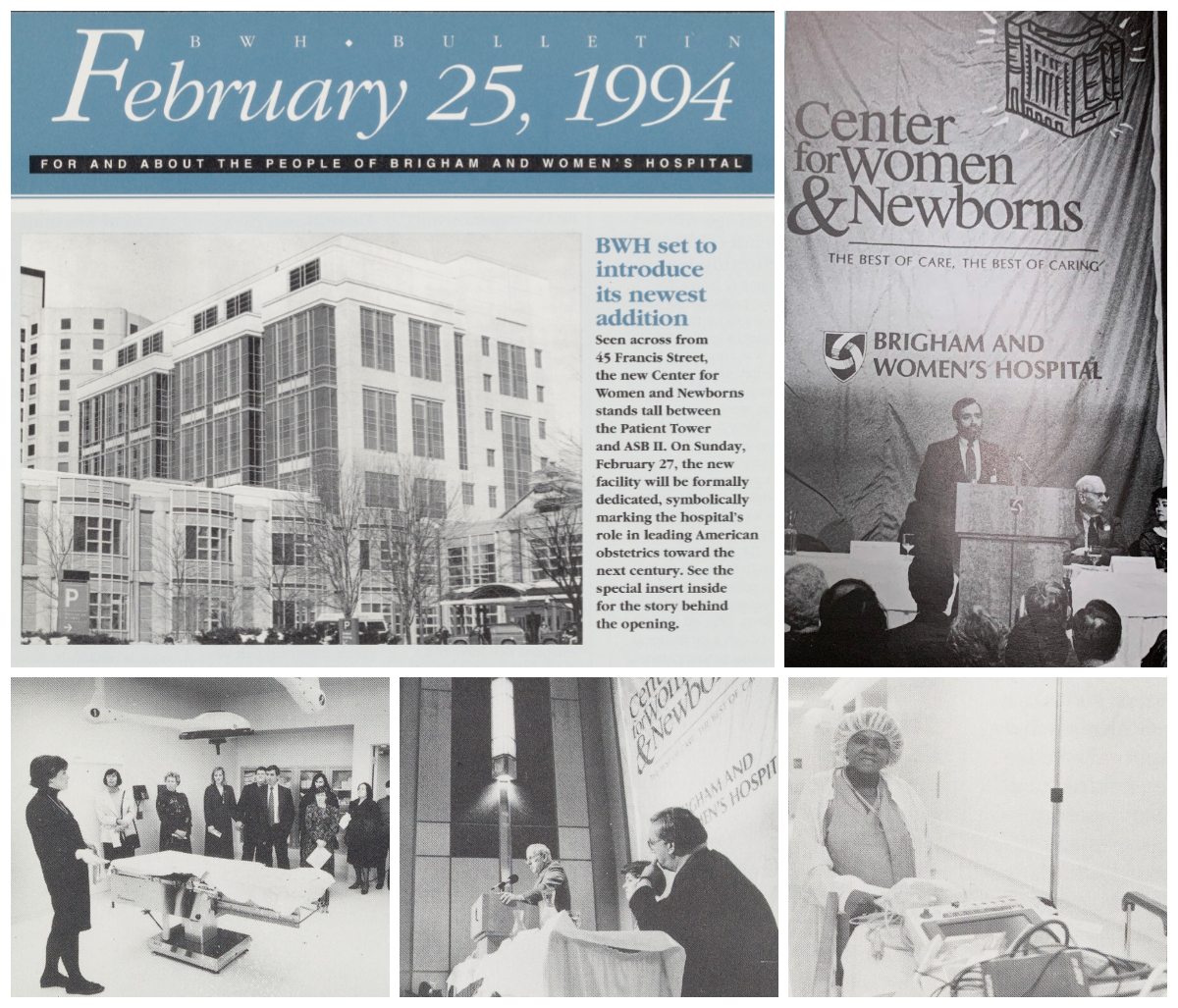
Top row, from left: BWH Bulletin covers the completion of CWN in 1994; Robert Barbieri, MD, speaks at the dedication ceremony in the building’s lobby area. Bottom row, from left: Staff nurse Patti Fitzgerald, RN, gives a tour of “a cesarean/complicated birth room”; H. Richard Nesson, MD, speaks at the podium as Boston Mayor Tom Menino listens; Icilda Chambers, patient care assistant, “uses a patient bed to give delicate equipment a cushioned ride to its new home,” the Bulletin wrote.
Exactly 30 years ago today, on Feb. 27, 1994, the Brigham celebrated the completion of its new Center for Women and Newborns building, marking the first addition of inpatient space since the Tower’s construction in 1981.
Patient care activity in the building was rolled out gradually in the weeks and months following the ceremony, with floors L2 through 6 starting to open in mid-March, followed by the rest of the building in June of that year.
Even then, the Brigham delivered more babies than any other hospital in Massachusetts, and its obstetric program was considered one of the largest in the country. Those facts remain true today, along with one more crowning achievement: For the past two years, the Brigham’s has ranked first in the nation for obstetrics and gynecology by U.S. News & World Report.
Another point of pride for the Brigham was being New England’s largest center for critically ill newborns, a status that also remains true today, with the new building boasting a 46-bed Neonatal Intensive Care Unit (NICU). Following the unit’s expansion in 2016, the NICU now has 66 beds and cares for nearly 3,000 premature and seriously ill babies and their families each year.
Perhaps no one is more acutely aware of the importance of these milestones than Anif McDonald, the first baby to be admitted to CWN’s NICU after the unit opened in March 1994.
“My parents always called me the miracle baby,” said McDonald, now 29 years old, who was born two months premature.
Although his family often recounted the story of his big “first,” McDonald said he regarded it as more of a tall tale.
“I’m overwhelmed not only that the story was true but also to better know the story of my birth,” he said.
After Brigham Bulletin reached out to McDonald to reconnect, he shared the message with his mother.
“She started bawling. She said, ‘I remember it like it was yesterday,’” McDonald recalled. “Most of all, my parents remember how helpful everyone was — the supervision, care and kindness. They really trusted you all — so much so that my dad was like, ‘OK, we can go home and get some sleep.’”
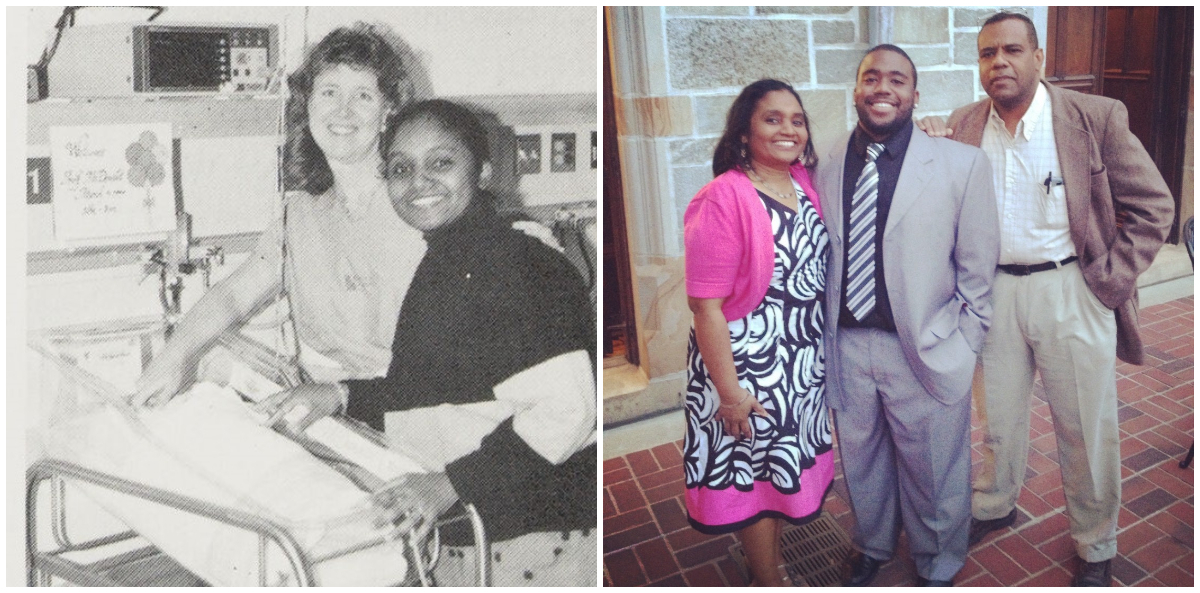
Left: Anif McDonald, then a newborn, is featured in the April 1, 1994, edition of BWH Bulletin with his mother, Denise, and NICU nurse Kathryn Healy-Thomson. Right: Thirty years later, McDonald and his parents (Denise and Anthony) say they remain deeply grateful for the exceptional care they received.
Looking at his life now, it is difficult to imagine it had such an uncertain start. Today, McDonald serves as the director of Community, Culture and Equity at Xaverian Brothers High School, his alma matter, in Westwood. He also coaches rugby at the school and plays the sport with a men’s league in Boston.
For families with a baby currently in the NICU, McDonald offered words of hope and reassurance.
“Your child will be OK. They are loved, and they will give back to you at some point in their lives,” he said. “It’ll all work out, and it’ll be a beautiful process. It might be tough right now, but it only gets more beautiful and brighter from here.”
That sentiment rang just as true three decades ago, when patient Eileen Sullivan, RN, the first known lung-transplant patient to subsequently give birth, spoke at a February 1994 ceremony celebrating CWN’s completion.
“I know that most of the expectant mothers who come to the center will not face the same situation that I faced, but my experience speaks to the high-tech, high-touch care that is provided to every new mother who comes here,” Sullivan said at the time. “I’m very glad that this hospital is here for regular people like me who just happen to have unusual problems. The way I see it, miracles happen at Brigham and Women’s every day.”