
New respiratory team elevates care for tracheostomy patients
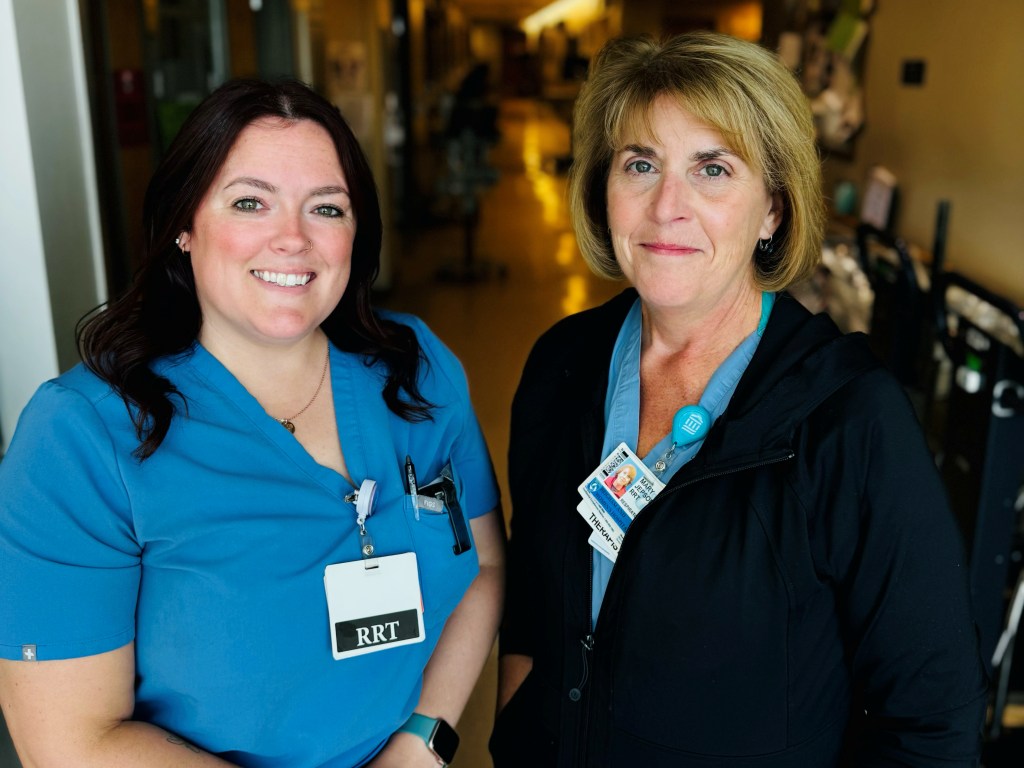
From left: Founding members of the Tracheostomy Team, respiratory therapists Ashley Grace and Mary Jepson
Respiratory therapists Ashley Grace, RRT, and Mary Jepson, RRT, recently reflected on one of the many patients who left an indelible impression on them.
Grace remembers the moment she placed a cap on the patient’s tracheostomy or “trach” tube — a surgical opening in the lower throat that provides an alternative airway for breathing — allowing them to use their upper airway again and restoring their ability to speak.
Jepson called the patient’s sisters, who cried tears of joy because they had not heard their sibling’s voice in months.
Two days later, Grace told the patient, “You look amazing.”
“I look amazing because of you,” the patient responded.
Moments like these have affirmed for Grace, Jepson and their colleagues the need to provide more intensive, dedicated support for patients with tracheostomies. To support this goal, Pulmonary Services recently launched an interprofessional Tracheostomy Team, aimed at delivering specialized care to support this patient population.
Respiratory therapist and educator Susan Sullivan, RRT, has been a driving force in bringing the team to fruition. The program’s goals include providing safe and high-quality trach care, standardizing order sets, optimizing communication between services, and quickly identifying patients who will benefit from a speaking valve, capping trial and decannulation (removal of the trach tube) when safe. Decannulation is an important milestone for trach patients because it means they will progress to rehabilitation or return home.
The team is also structured to enhance family and patient education, improving discharge safety as well as patient satisfaction.
“I am so proud of the hard work and care provided by the Trach Team,” Sullivan says.
Thanks to the establishment of the new team, Grace and Jepson say they can dedicate more time with tracheostomy patients to help them achieve their goals of care and provide extended patient education. In addition to enhancing quality and safety, the effort has enabled Grace and Jepson to establish closer connections with both patients and their families.
“In the past couple of months that Ashley and I have been working with these patients, we’ve had some great successes,” Jepson says. “I feel really good about the work we’ve done just in this brief period of time.”
‘Making a huge difference’
An important function of the team is enhanced communication. Respiratory therapists, nurses, physicians, care coordination staff and speech therapists meet weekly to discuss the care and progression of each patient. Biweekly meetings are held to discuss what is or is not working well within the team. A larger group of multidisciplinary clinical leaders meet with the team monthly to exchange feedback as well.
Prior to the team’s launch, Pulmonary Services performed an estimated two decannulations per month. Now, they perform about four per month, for a total of 35 decannulations since April. The Tracheostomy Team has also seen more patients discharge directly home, rather than to a rehabilitation facility, says Jill Robinson, MHA, RRT-NPS, director of Pulmonary Services.
“Even though it’s not an enormous number of patients, you’re making a huge difference in the lives of those who need this specialized care,” she says.
Another change the team implemented was to create consistent expectations for when patients should reach milestones like capping a trach tube, inserting a speaking valve or decannulation.
Brian Yorko, MBA, BSN, executive director of Inpatient and Clinical Services, describes how these changes have enhanced patient satisfaction and overall quality of life.
“The team pulled together standardized orders and documentation to create a process for consistent care across the Brigham,” he says. “Patients can return as quickly as possible to their normal lifestyle.”
The key to the success of the program, Yorko emphasizes, is collaboration.
“A hub-and-spoke model, with the patient in the middle, creates better teamwork and better patient outcomes,” he says.