
Through Collaborative Care, PAMSA Clinic Brings New Hope to Patients with Complex, Degenerative Movement Disorders
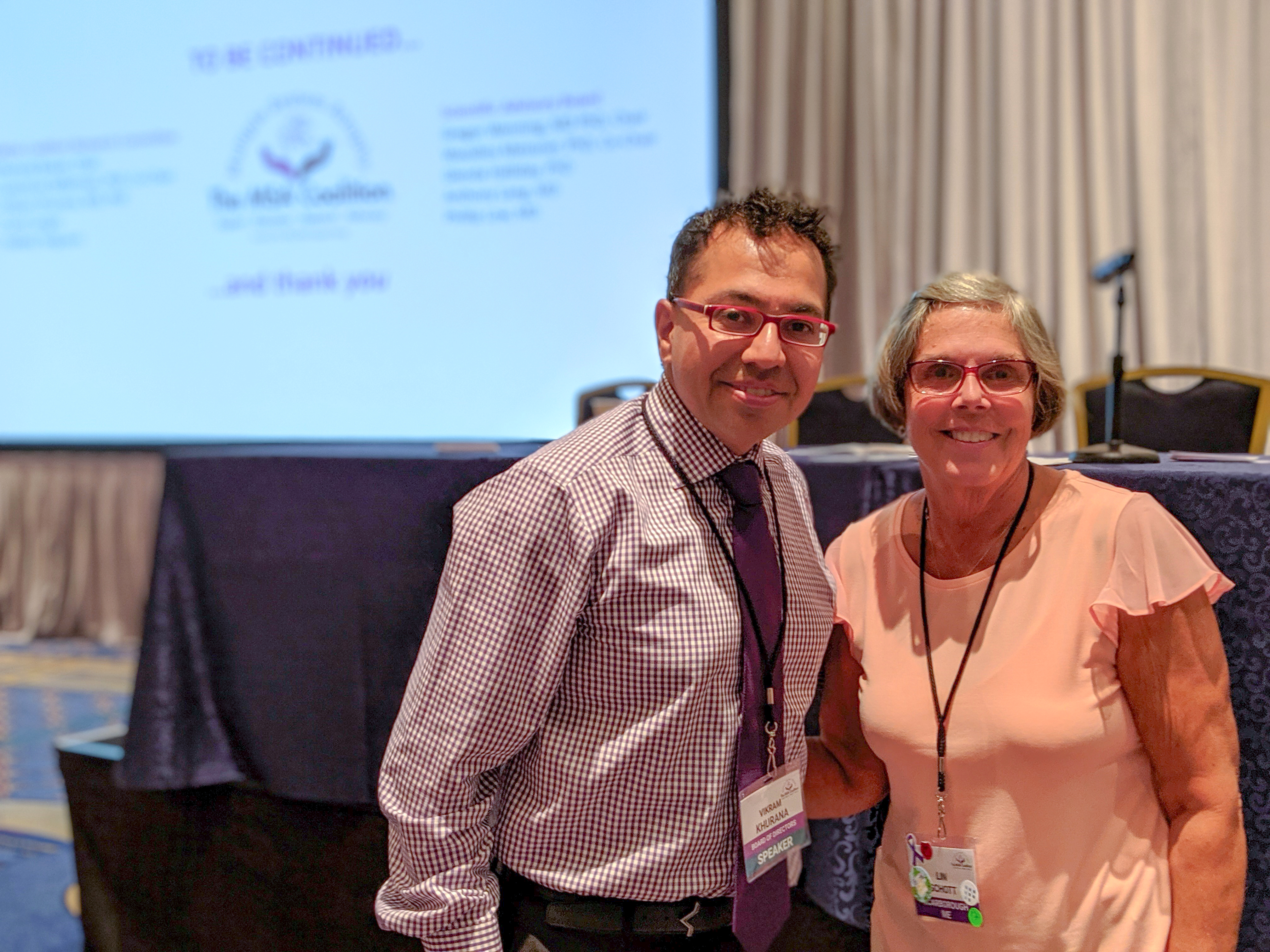
From left: Brigham neurologist Vikram Khurana shares a moment with one of his patients, Lin Schott, at an event hosted by The MSA Coalition. Schott, who has multiple system atrophy (MSA), is one of 23 participants in a Brigham-led cohort study of people with this rare neurodegenerative disease and similar disorders.
In 2017, at age 68, Lin Schott’s active lifestyle was cut short. A former U.S. Navy nurse who organizes activities and athletic events for disabled veterans and their families, Schott was walking with a group of friends when she suddenly felt like she couldn’t stop moving, despite being exhausted. From there, she started having falls she couldn’t account for.
“I’d get out of bed and just fall,” she recalled. “My balance was really off.”
She was also experiencing nausea and constipation. She saw her primary care physician, who referred her to a neurologist at Massachusetts General Hospital (MGH).
Anne-Marie Wills, MD, Schott’s primary neurologist at MGH, diagnosed her with multiple system atrophy, or MSA. MSA belongs to a group of rare neurological diseases known as atypical parkinsonisms, a term for a group of conditions that affect movement and are named for their similarity to Parkinson’s disease. MSA is a progressive neurodegenerative disorder that causes loss of function along with a multitude of other symptoms, including impairments to balance, blood pressure issues and sleep disturbances, among other issues.
Wills, who specializes in neurodegenerative diseases, referred Schott to the Brigham to obtain a second opinion from neurologist and autonomic specialist Peter Novak, MD, PhD, who is part of the multidisciplinary team that makes up the Brigham’s Parkinson’s+Ataxia+Multiple System Atrophy (PAMSA) Clinic. The referral is just one example of not only the two departments’ longstanding collaboration but also Mass General Brigham’s vision for a fully integrated and unified system of care.
Novak not only confirmed Schott’s MSA, but also identified another diagnosis: autoimmune autonomic ganglionopathy (AAG), a very rare disease that causes the body to attack parts of the nervous system that control involuntary (also known as autonomic) functions like heart rate, blood pressure and digestion. Only about 100 people in the U.S. are diagnosed with AAG each year.
First established in 2017, the PAMSA Clinic combines neurology with other clinical specialties and services to care for patients with complex, degenerative movement disorders. Held twice per month, the clinic provides patients the opportunity to be evaluated by three different specialists — including a movement disorders specialist, a neuro-physical therapist and social worker — in consecutive appointments.
‘Beyond Neurology’
Recognizing that patients with these complex disorders need more than neurological care, the PAMSA Clinic brings together a wide range of experts in related areas. The team also includes speech and occupational therapists, a genetics counselor, neuroradiologist, neuropathologist, neuro-nuclear medicine physician, pulmonologist and urologist.
On the first Friday of each month, the clinic’s core team meets to discuss cases and develop a cohesive plan for diagnosis and treatment.
“For some of our patients, the problem goes beyond neurology. They can sometimes seem like they have Parkinson’s disease, but it turns out they don’t respond to conventional treatments, and they tend to progress more quickly,” said Vikram Khurana, MD, PhD, chief of the Division of Movement Disorders in the Department of Neurology and co-director of the PAMSA Clinic.
Khurana said early falls like what Schott experienced are a common sign of MSA. Patients may also have early autonomic dysfunction, such as bowel and bladder issues, making the clinic’s collaborative and multidisciplinary approach an essential component of its care model.
“If we need an expert urology consult or cardiologist, they’re there,” said Khurana.
Barbara (Kelly) Changizi, MD, clinical director of the Division of Movement Disorders and co-director of the PAMSA Clinic, said social work is another key area for patients adjusting to life with a degenerative movement disorder.
“Some of our patients might be younger and thought they could work for another 20 years. If they can’t anymore, we can navigate those resources,” Changizi said. “If they need help paying for medication or need a wheelchair or stretcher to get them to their appointment, we can help.”
Advancing the Future of Care
The PAMSA clinic, which was recently named an MSA Center of Excellence by the MSA Coalition, is not the only center of its kind in Boston but stands apart for its leading work in research. The very nature of rare diseases — that they affect so few people — makes them unlikely targets for research funding and clinical trials. The Brigham’s PAMSA Clinic is one of the few of its kind to offer patients with these disorders the opportunity to participate in studies that seek to discover better treatments for movement disorders.
Schott receives most of her clinical care from her primary neurologist at MGH, and she also plays a key role in helping Brigham researchers uncover future treatment options for other patients diagnosed with MSA.

Schott (center) with her granddaughters, who organized a lemonade stand to support people with MSA.
She’s one of 23 participants involved in the Brigham’s MyTrial study, which follows people with MSA, Parkinson’s disease and/or spinal cerebellum ataxia over a two-year period as researchers monitor different ways in which their disease progresses.
“We’re looking to see if the patients are slowing down or if there’s a tremor,” said Diego Rodriguez, MD, a clinical research fellow in the Department of Neurology. “We’re also measuring their eye movements because impairment patterns are different between ataxia and parkinsonism.”
Researchers use the data to predict if their condition is worsening over the two-year period and if it’s responding to different medications.
Another study offered through the PAMSA Clinic, the Harvard Biomarker Study 2.0, performs brain scans and runs lab tests on skin biopsies in hopes of identifying better ways to diagnose and treat Parkinson’s disease. Schott will be enrolled in the study in August.
Researchers have already learned how to distinguish MSA from Parkinson’s by comparing proteins found in participants’ skin samples.
“That differentiation can help with an early, accurate diagnosis,” Rodriguez said.
Those skin biopsies can also be combined with stem cell models to create a replica of an individual patient’s disease.
“Now that we have those models, we can treat the cells with compounds to see if they work, ultimately leading to the development of new drugs,” Rodriguez said.
Defying the Odds
To treat her AAG, Schott receives intravenous immunoglobulin infusions (IVIG), a therapy for patients with weakened immune systems, something Rodriguez said could also be helping her MSA by targeting inflammation in her brain.
“There’s a good chance, but more research is needed,” he said.
Novak noted that other patients with MSA who have elevated inflammatory markers similar to Schott have also been treated with IVIG or other immunomodulators.
“The combination of autoimmunity and MSA is intriguing and worthy of being studied,” said Novak.
Schott also gets Botox injections in her legs, bladder and esophagus to help treat her symptoms, sees a speech therapist, and does tongue exercises to control swallowing issues. As her disease progressed, she moved to a one-story home and now uses a walker. Despite the need for lifestyle changes, she has defied the odds.
“They told me I’d likely be in an electronic chair in five years. I said, ‘Not me. I’m going to fight this,’” Schott said.
Schott said she eats well, enjoys going on walks, visits with her five children and grandchildren, and volunteers as much as she can.
“Taking care of myself and all these doctors meeting my needs are keeping my condition from progressing as quickly,” she said.