
From Fellowship Dream to Global Impact: Brigham Endocrinologist Leads International Effort to Transform Diabetes Care in Crisis Settings
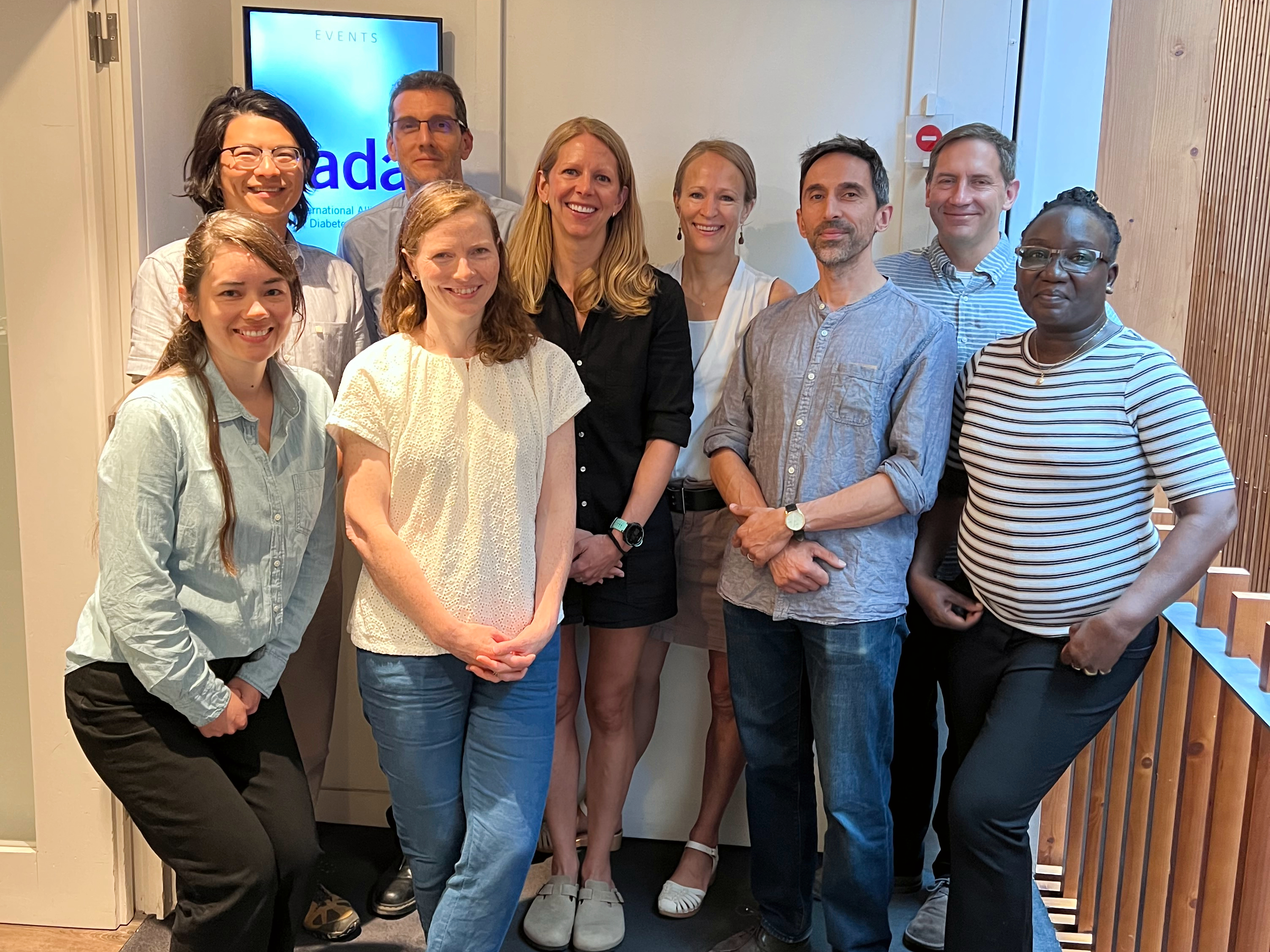
“The Brigham was the birthplace and the catalyst of IADA,” says Sylvia Kehlenbrink (fifth from left), pictured with her colleagues at the International Alliance for Diabetes Action, a global nonprofit she founded and leads.
When Sylvia Kehlenbrink, MD, interviewed for the research track of the Brigham’s Endocrinology Fellowship Program in 2015, she was transparent about her unconventional ambitions.
“I already knew I wanted to work on improving diabetes care in humanitarian settings,” said Kehlenbrink. “I told them I wouldn’t be following a traditional NIH-funded research path, but that I loved this work, the Brigham’s program and its people.”
To Kehlenbrink’s delight, she was accepted into the program with open arms and, over the years that followed, received continued support for her dream to ensure vulnerable people have access to diabetes care during a humanitarian crisis, such as war, famine, environmental catastrophe or civil unrest.
Today, in addition to being a practicing endocrinologist and director of Global Endocrinology at the Brigham, Kehlenbrink is also the founder and chair of the International Alliance for Diabetes Action (IADA).
Born out of work she started as a fellow, this global partnership of over 100 humanitarian organizations, intergovernmental and United Nations agencies, academic institutions, philanthropic organizations and the private sector work together to enhance care for people living with diabetes in humanitarian crises.
“The Brigham was the birthplace and the catalyst of IADA, and the support of the Division of Endocrinology and the Department of Medicine is not something I take for granted,” said Kehlenbrink, who is also founding director of the Diabetes in Humanitarian Crises Program at Harvard Humanitarian Initiative. “They gave me the platform and supported me throughout my fellowship. Without that, none of this would have ever happened.”
Targeting Four Key Areas in Diabetes Care
IADA focuses its work in four key target areas, as outlined in the Boston Declaration: advocacy, access to medicines and diagnostics, clinical and operational guidance, and data and surveillance.
Recent achievements include driving and facilitating the 2021 resolution by the World Health Organization (WHO) to improve diabetes care and access to insulin, and conducting the HumAn-1 Trial in Bangladesh and Tanzania, with the goal of improving clinical outcomes among children and young adults living with type 1 diabetes in low-resourced settings. A number of IADA members are also separately working with the WHO on much-needed guidelines for type 1 diabetes.
Kehlenbrink is proud that IADA “has accomplished quite a bit with very few resources,” and was thrilled this past December when the alliance received a three-year, $2.6 million seed funding grant from The Leona M. and Harry B. Helmsley Charitable Trust. The new grant will not only allow IADA to sustain its ongoing efforts but also expand on them.
“It’s been a big boost to get the support of a committed multiyear donor that really sees what we’re trying to do and is willing to help,” said Kehlenbrink. “We’re extremely grateful.”
Endless Possibilities
That fateful fellowship interview in 2015 also left a lasting impression on Ursula Kaiser, MD, chief of Endocrinology, Diabetes and Hypertension, who was the one conducting it.
“I was highly impressed by Sylvia’s commitment to serving vulnerable populations globally. I was delighted that, together, we were able to forge a unique fellowship training program for her,” Kaiser said. “Sylvia’s firm commitment and clear vision enabled her to develop a highly successful career path to provide diabetes care for vulnerable and marginalized global populations.”
Kehlenbrink tears up when thinking about that moment and all the time and space since then that she’s been given to pursue her passion. She’s also grateful for the continued support of her colleagues — including mentor Marie McDonnell, MD, director of the Brigham’s Diabetes Program and her biggest cheerleader — and that she is in the best place to make an even bigger impact.
In particular, she draws inspiration from the Brigham’s long commitment to advancing global health equity — a legacy that is perhaps most palpable in the hospital’s connection to, and continued collaboration with, Partners In Health. The global humanitarian nonprofit, which provides health care to millions of people in the poorest areas of the world, counts two former Brigham residents among its co-founders: the late Paul Farmer, MD, PhD, and Jim Yong Kim, MD, PhD.
“Partners In Health grew out of the Brigham and is now a standalone nonprofit that closely collaborates with the Brigham,” Kehlenbrink said. “The clinical, research and teaching expertise here are all off the charts. The possibilities for IADA are endless. I’m excited to see how this next phase evolves. With time, might we expand? I think the answer to that is yes.”
Today, Kehlenbrink is busy preparing for IADA’s fourth annual symposium in May 2024 in Athens, Greece, and is inching closer to IADA’s vision of a world where people affected by humanitarian crises will have access to affordable medications, diagnostics and quality care for diabetes.
She is also thinking about how their work can be a model for other non-communicable diseases (NCDs).
“Diabetes affects over half a billion people globally and is one of the more complex NCDs to manage,” she explained. “It requires an uninterrupted supply of essential medicines and diagnostics, continuity of care, maintenance of a cold chain, monitoring and management of comorbidities – including cardiovascular risks – and comprehensive education and support for individuals with diabetes. I believe that if we can effectively provide diabetes care, we can arguably manage just about any other NCD in humanitarian settings.”