
Meet the BWHers helping to make the skies safer
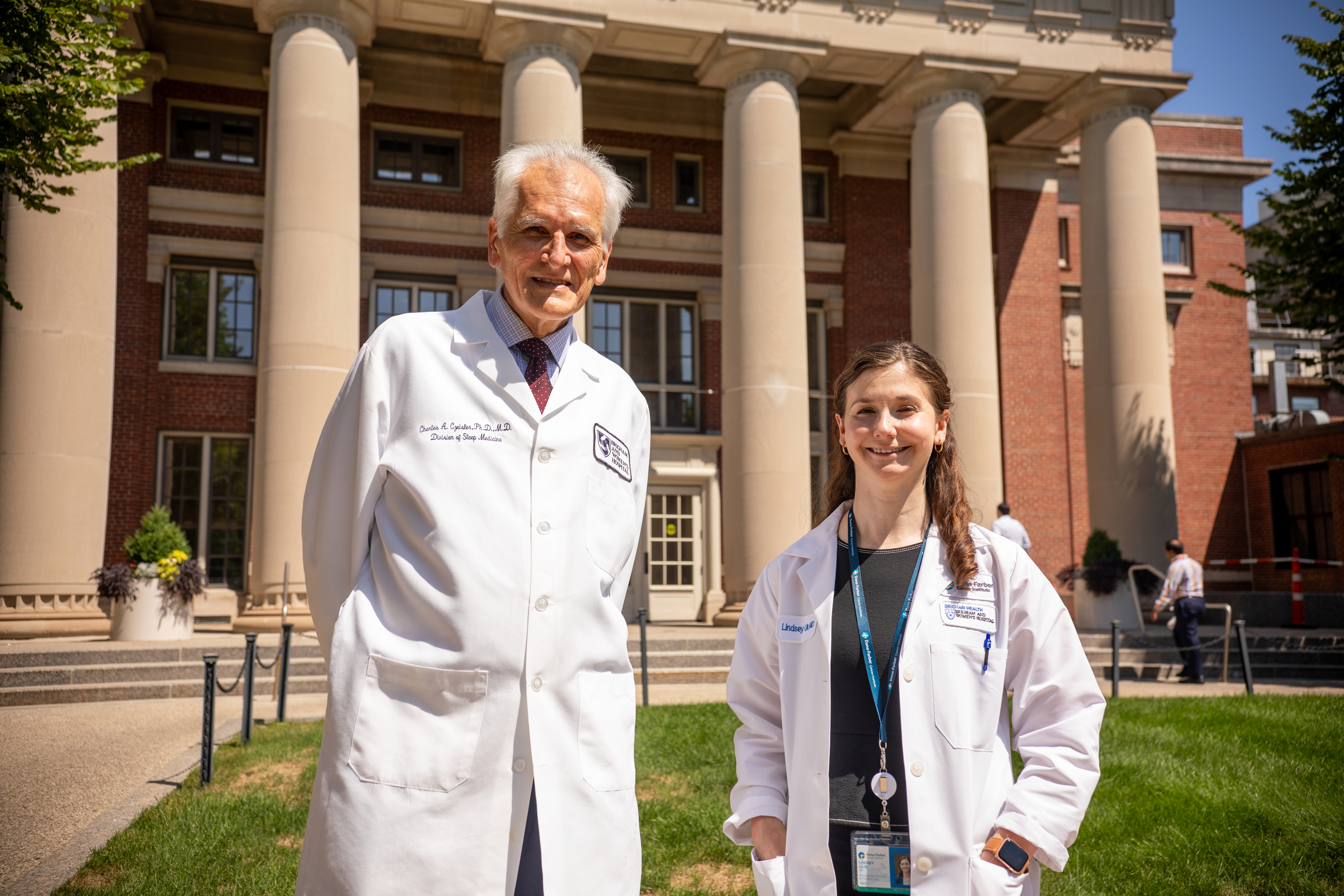
From left: Charles Czeisler and Lindsey Ulin
Brigham resident Lindsey Ulin, MD, was on a Southwest Airlines flight in 2023 when her face and chest began to feel hot and itchy. Her sister, sitting beside her on the plane, noticed Ulin was breaking out in hives. A few moments later, she began to have trouble breathing.
As a physician, Ulin immediately recognized the terrifying symptoms of anaphylaxis, a life-threatening allergic reaction. Through her panic and confusion — to her knowledge, she had no food or medication allergies — she knew the one thing she needed was epinephrine. But when Ulin and her sister flagged down a flight attendant to get help, they couldn’t believe what they heard next: The airline’s on-flight emergency medical kits didn’t contain epinephrine auto-injectors, known more commonly by the brand name EpiPen.
Their only option was epinephrine in a vial, which would need to be dosed appropriately, drawn into a syringe and injected into muscle — actions that take time, precision and medical expertise. Ulin survived the ordeal only because there was another physician on the flight who assisted.
“Once I was stable and getting close to being able to leave the hospital, I started looking into this because I really could not fathom how this was legal, and I was horrified to find out it wasn’t just Southwest,” said Ulin, now a Palliative Care fellow at the Brigham, who wrote about her experience in a Boston Globe op-ed that attracted the attention of key lawmakers. “It was every airline, and the FAA hasn’t required them to update their kits since 2006.”
Exactly 40 years prior, a different revelation about flight safety had come to light — not quite as acute, but no less impactful.
Charles Czeisler, MD, PhD, then just starting out his career as a sleep medicine physician and researcher, testified before Congress in 1983 about how air traffic controllers’ grueling work schedules contributed to fatigue and exhaustion — endangering not only their health and safety but also the public at large. It was an open secret that they dozed off on the job or napped at work. During their commutes home, one in three reportedly fell asleep behind the wheel. After hearing testimony about this from Czeisler and other experts, then-Rep. Al Gore of Tennessee challenged Federal Aviation Agency (FAA) officials to explain these work schedules, demanding to know how they could be safe.
And yet, little has changed since then. So, when Czeisler was tapped for his expertise again last December — this time, to serve on scientific panel advising the FAA on how to address fatigue among air traffic controllers — he felt he had a duty to participate. Then again, the solution hadn’t changed in four decades: Air traffic controllers needed more rest between shifts. Would policymakers listen this time?
“If air traffic controllers are so tired they can no longer focus, it can have horrible consequences,” said Czeisler, who serves as chief of the Brigham’s Division of Sleep and Circadian Disorders. “It’s like being an alcohol researcher and seeing people drink and drive. You would feel an obligation to champion efforts to change public policy. It’s no different with sleep deprivation. That’s why I have continued this work for the past 40 years.”
Although Ulin and Czeisler have traveled different paths, they share the same destination: making the skies safer for travelers nationwide. Using their time, talents and platforms, both BWHers’ tireless advocacy succeeded in helping enact new FAA policies designed to enhance the health and safety of people in the air and on the ground.
‘The power of community’
To help get her message out, Ulin worked closely with Mass General Brigham’s External Communications and Government Affairs teams on writing an op-ed and bringing it to the attention of lawmakers, including Sen. Ed Markey of Massachusetts and Sen. Tammy Duckworth of Illinois. She also drew on the experiences of her co-residents and mentors, many of whom had participated in advocacy and policy work before.
“Anybody can tell their story, but it takes knowledge and skill to do it in a way that reaches the right person at the right time,” Ulin said. “Government Affairs helped me get meetings with staffers for Sen. Markey’s office a year ago and taught me how to pitch my message effectively, since they have such limited time. I was very excited to see him team up with Sen. Elizabeth Warren. It was great to leverage the power of community we have here at MGB.”
Through her efforts, Ulin also discovered many others had been championing this issue for years already, including the Asthma and Allergy Foundation of America, and she was humbled to add her voice to the chorus demanding change.
This May, Congress passed legislation that will require the FAA to update its on-flight emergency medical kits to include, among other things, an epinephrine auto-injector. The law also requires the FAA to reevaluate kits’ required contents every five years, ensuring they contain supplies that are aligned with the latest medical advances.
“I think it speaks to the long game with advocacy. Change takes a long time, but it can happen,” she said. “My main message for other trainees is to lean on the network you have here and get involved with things you haven’t tried before. You don’t know the impact you can have. A lot of us are attracted to places like the Brigham to learn how to be good doctors, but there is so much more we can do with this platform.”
‘A once-in-a-generation opportunity’
After being tapped for a three-person scientific panel last December, Czeisler and colleagues spent the next 10 weeks reviewing scheduling data for more than 10,000 air traffic controllers, conducting 25 meetings and interviews, and visiting four air traffic controller facilities around the country. In all, their 114-page report contained more than 50 recommendations to reduce fatigue risks. To Czeisler’s amazement, the report had immediate policy impact, leading FAA Administrator Michael Whittaker to issue a directive to increase time off between shifts within 90 days.
The nature of air traffic controllers’ work requires intense, continuous vigilance for sustained periods of time. They often work what is described as a “counterclockwise” rotating schedule, meaning shifts start earlier and earlier as the week goes on — working against humans’ natural circadian rhythms.
And the riskiest aspect of scheduling, panelists argued, is the widespread use of a “rattler” shift, in which a controller works both a day shift and an overnight shift in a single 24-hour period, with only nine hours off in between, allowing insufficient time to commute home and get enough sleep before returning to work.
This July, the FAA and the union representing air traffic controllers announced an agreement to implement several key recommendations from the panel, which also included former Brigham researcher Erin Flynn-Evans, PhD, MPH, who now serves as director of the Fatigue Countermeasures Laboratory at NASA, and Mark Rosekind, PhD, a former Executive Council member of Harvard Medical School’s Division of Sleep Medicine who served as a member of the National Transportation Safety Board and administrator of the National Highway Transportation Safety Administration.
Starting next year, air traffic controllers must receive at least 10 hours off between shifts, and at least 12 hours off before and after an overnight shift. Controllers will also have new limitations on the number of consecutive overtime assignments they can accept.
For Czeisler, who has been studying this population since he was a medical student, the swift and decisive response was nothing short of joyous.
“It’s a once-in-a-generation opportunity to have someone at the very highest level taking this important safety issue into consideration, and we were very pleased to see such action,” he said.
Czeisler hopes that public officials will continue to be receptive to the input of medical experts, whose knowledge of biology and physiology can make systems safer for everyone, he added.
“As physicians, we often have a special perspective — having either done the research or treated patients with a particular condition,” Czeisler said. “If health care providers and scientists don’t have a seat at the table, these decisions are often hashed out between labor and management, who might not focus on solutions that also improve health and safety. I think we have an obligation to be that voice.”