
Brainwaves and brushstrokes: Neurology fellow creates abstract art inspired by the brain
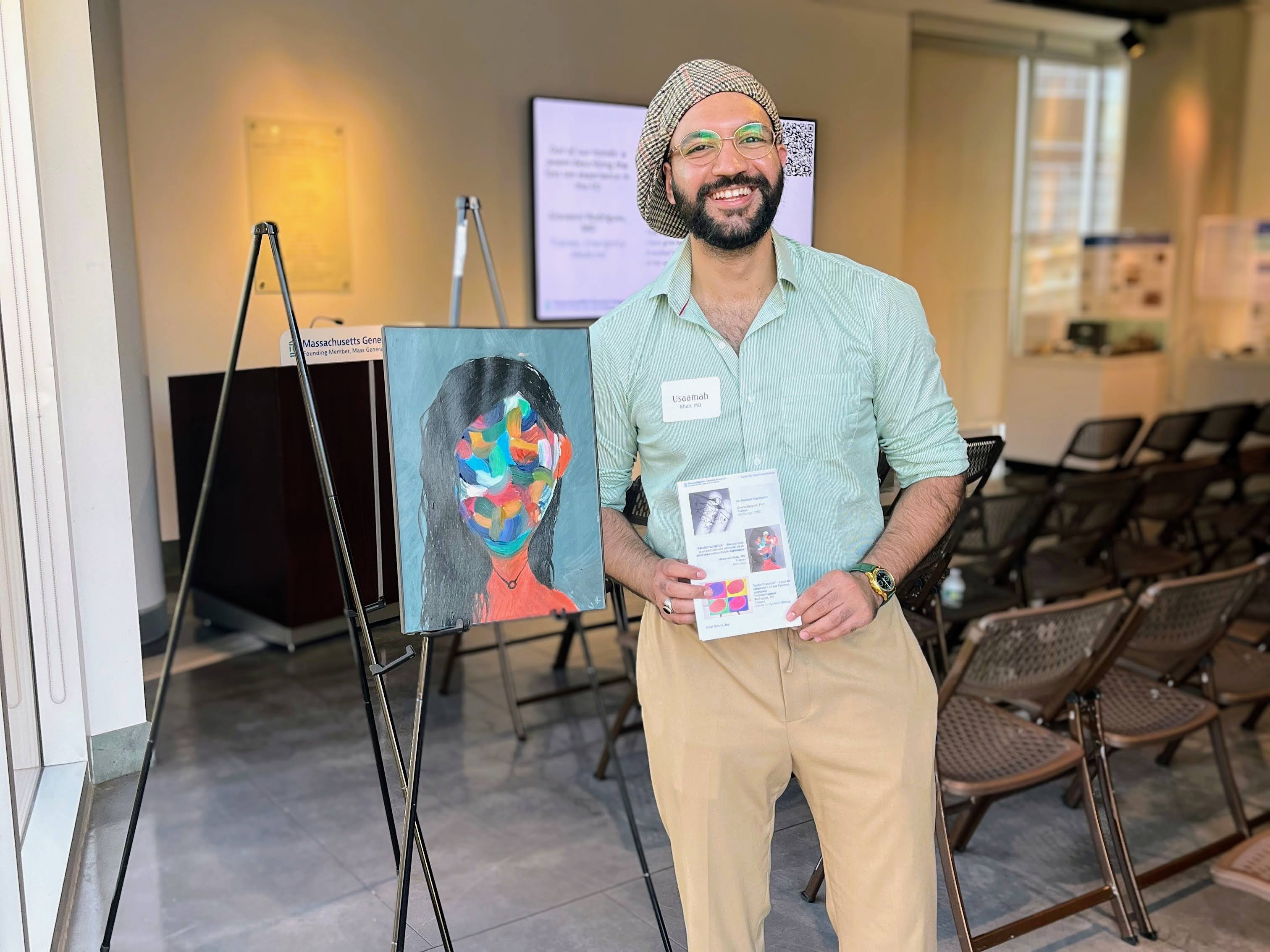
Usaamah Khan showcases one of his paintings selected for the cover of Neurology Clinical Practice, “Prosopagnosia,” an abstract interpretation of the cognitive disorder more commonly known as face blindness.
During his time as a Neurocritical Care fellow at the Brigham, Usaamah Khan, MD, performed many brain death assessments, a process by which a physician determines that all meaningful neurological activity has ceased. While each encounter is poignant and meaningful in its own way, one experience with a dying patient and her family left a profound impression on Khan.
Touched by this particular moment, he channeled his emotions into paint on canvas. Sweeping brushstrokes of navy blue, slate grey and white evoke the painting’s title, Stillness amidst a Storm. In an artist statement for the painting, he wrote that while this type of neurological exam is not uncommon, “something about this specific encounter, with the presence of her entire family during the examination felt particularly powerful, almost spiritual.”
“I could sense her warmth even through the coldness of her extremities,” he wrote. “As a complete stranger, I was present in the most defining moment of her life as she transitioned to the beyond.” It was a profound experience, he wrote, “To be the last person to have touched her, to have paid intensely deep attention to the most subtle elements of her sense of being, and then share a moment of silence, solitude and calmness with her family as the storm of her passing swept silently across the room.”
Khan, who recently began his Epilepsy fellowship at Massachusetts General Hospital (MGH) and continues to be involved with neurology training at BWH’s STRATUS Center for Medical Simulation, started oil painting about five years ago, during his residency. Much of his art, inspired by neurological diseases and his patients, conveys complex emotional experiences but remains open to the interpretation of the viewer.

Khan works on a piece that depicts the use of various colors and their meaning in perfusion scans for stroke patients.
Two of his paintings, Dystonia and Prosopagnosia, were recently chosen as cover art for Neurology Clinical Practice.
Learning more about the brain was what originally prompted Khan to try his hand at painting. “I became fascinated with this whole idea of left brain versus right brain,” he said. “When you understand the brain a little bit better, you realize and appreciate that it’s a lot more complex and it’s a lot more fluid than those broad categories.”
This understanding mirrors and influences Khan’s abstract style.
“You think of some of the Renaissance arts that are very fine and sharp and detailed, and that’s never really been my style of art,” said Khan.
When you look at a realistic portrait or scenery, he explained, “You know what you’re seeing, and you appreciate how perfectly that’s been captured by the artist. And then there’s forms of art where you’re looking at it and you’re not entirely sure what you’re seeing, but it inspires you to think a little about what exactly is trying to be captured.”
In his case, Khan seeks to portray an abstract interpretation of neurological disease and the patient experience. To capture these layers of meaning, oil is often his medium of choice because it lends itself well to the blending of shapes and colors. But Khan’s approach to painting in this style requires adaptability, because the end product might not end up looking like what he initially had in mind.
There’s a parallel to be drawn there, he said, with clinical work. “When you’re dealing with complex cases and complex patients, a provider has to always be willing to reset biases, reset their frame of thinking and go back to the drawing board.”
Khan’s paintings have been featured in the Paul S. Russell, MD, Museum of Medical History and Innovation at MGH, but mostly, they are a personal collection of his. Some are displayed on a gallery wall in his apartment.
“I definitely don’t identify myself as a painter. I think artistic skills are built over many, many years,” said Khan. “I truly consider myself an absolute novice in this area.”
Khan’s advice to those interested in painting or trying something new is simple: Don’t pressure yourself to be perfect. “I don’t think anyone picks up a paintbrush and creates a masterpiece the first time they give it a shot,” he said. “If the process brings you happiness, the end result shouldn’t deter you from doing it.”