
From Benin to Boston: Nurturing the next generation of neurosurgeons beyond the Brigham
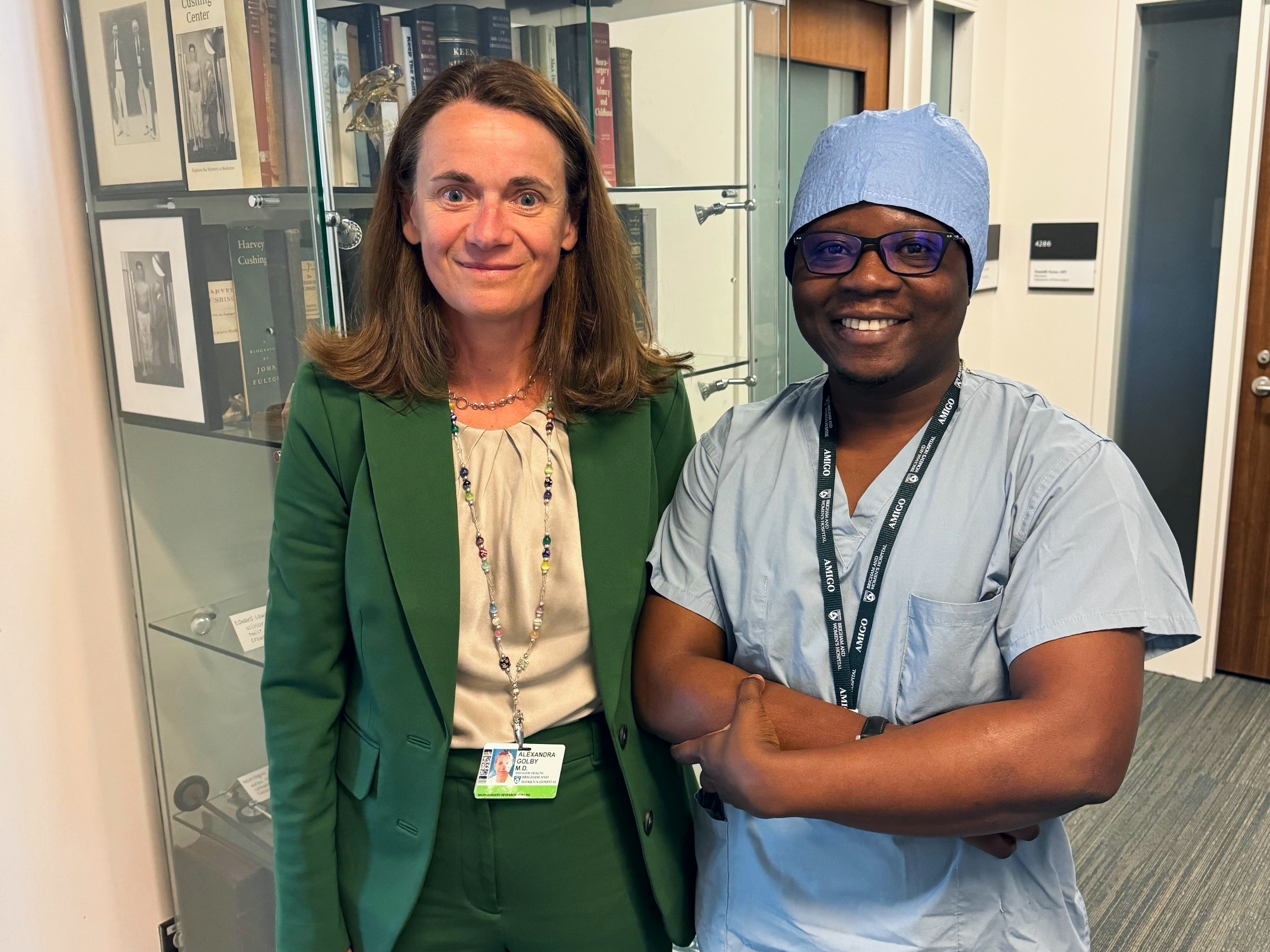
From left: Neurosurgeons Alexandra Golby and Fortuné Gankpé
Benin is a French-speaking country in West Africa of 13 million people, roughly as populous as the city of Tokyo. Yet the entire nation has only 10 neurosurgeons.
One of them is Fortuné Gankpé, MD, FWFNS, who is completing a three-month observership at the Brigham under the guidance of Alexandra Golby, MD, director of Image-Guided Neurosurgery and co-director of the Advanced Multimodality Image-Guided Operating (AMIGO) suite.
Gankpé — an attending neurosurgeon in Benin’s largest hospital, CNHU Hubert Maga of Cotonou — came to the Brigham to enhance his skills in treating brain cancer and using image-guided techniques in surgery. His endeavor is supported by the Foundation for International Education in Neurological Surgery’s Bassett Fellowship program, a traveling international fellowship for neurosurgeons from low- to middle-income countries. After recently concluding his BWH observership at the end of June, he now embarks on a six-month fellowship at Massachusetts General Hospital.
“In my country, we don’t have a neurosurgical training program, so all of us Beninese neurosurgeons have to go abroad, usually to Morocco, which is where I did my residency,” Gankpé said. “To be the first Beninese neurosurgeon at the Brigham — one of the best neurosurgery departments in the world and where neurosurgery itself was born — has been truly amazing.”
When Gankpé initially contacted Golby to inquire about an observership, he was familiar with only her reputation — as a world leader in neurosurgery. Despite having no prior personal connection, he decided to take a chance and see if she would be willing to host him. To his delight, she warmly accepted.
“I have hosted neurosurgeons from developing and middle-income countries for many years, and I consider it a key part of my mission,” Golby said. “Building neurosurgical manpower is a big challenge because it takes a lot of time, experience and expertise to make a neurosurgeon.”
Gankpé, who completed a neurosurgery fellowship in Guadeloupe and a neuro-oncology fellowship in France, is especially interested in improving care for patients with brain cancer. Given the extreme lack of specialists, he explained, patients with brain tumors have few options for treatment in Benin.
He recalled how last year he cared for a pregnant patient with a meningioma — a tumor that compresses the brain, causing severe neurologic problems and possibly death — who had been turned away by other surgeons in Benin due to the complexity of her case. The woman had weakness on one side and was unable to walk.
“I reached out to colleagues in obstetrics and anesthesiology, and we did a lot of planning. We decided to perform the surgery, and it was very successful,” Gankpé said. “She recovered completely and gave birth three months later to a healthy baby.”
In addition to shadowing Golby and her colleagues — including Ossama Al-Mefty, MD, Omar Arnaout, MD, Linda Bi, MD, PhD, and Nirav Patel, MD — Gankpé spent a few weeks of clinical rotations in the Neurosciences Intensive Care Unit at BWH and the Department of Pediatric Neurosurgery at Boston Children’s Hospital. Reflecting on his experiences here, Gankpé said he is excited to incorporate what he’s learned in Boston into his practice at home, where he plans to launch Benin’s first multidisciplinary neuro-oncology department.
“We need to move neurosurgery to the next level in my country because these patients are already facing many challenges. I’d like to thank my mentors in Benin, Kisito Quenum, MD, and Thierry Alihonou, MD, who believe in me and are always pushing me to achieve this goal,” he said. “One important thing I learned here is how to operate without a brain retractor, which can cause contusions and other complications. By observing procedures here, I learned how we can avoid that and improve outcomes for our patients back home.”
Lasting impact
In addition to gaining new insights into surgical technique, Gankpé said he’s grateful for the opportunity to learn directly from U.S. colleagues and establish new professional relationships, especially Golby.
“I have really appreciated how open and helpful everyone here has been,” he said. “They have been happy to answer all of my questions, which has led to many interesting discussions.”
Longstanding programs in Morocco and South Africa have markedly grown neurosurgical capacity on the African continent, Golby said. But once these newly minted neurosurgeons return to their home countries, they are often working alone and without mentors. By hosting visiting colleagues from these parts of the world, the Brigham is building an international network of mentorship that benefits patients worldwide, she explained.
“One of my mentees is a neurosurgeon from Rwanda who had an opportunity to spend three months at the Brigham about seven or eight years ago,” Golby said. “I just heard from her recently when she sent me one of her cases and asked for some feedback.”
For Golby, these moments and her experience mentoring up-and-coming neurosurgeons like Gankpé underscore the importance and power of mentorship.
“I think there comes a time in your career where what you can leave behind is having influenced people for the better, and it seems to me that is my legacy,” she said. “I’ve written a lot of papers, attained professorship and all sorts of other stuff, but in terms of having an impact on the world — it’s to leave the next generation with new ideas, connections and mentorship. I feel it’s the most important thing I do after patient care.”