
The hair necessities: BWH introduces grooming products for patients with curly and coily hair textures
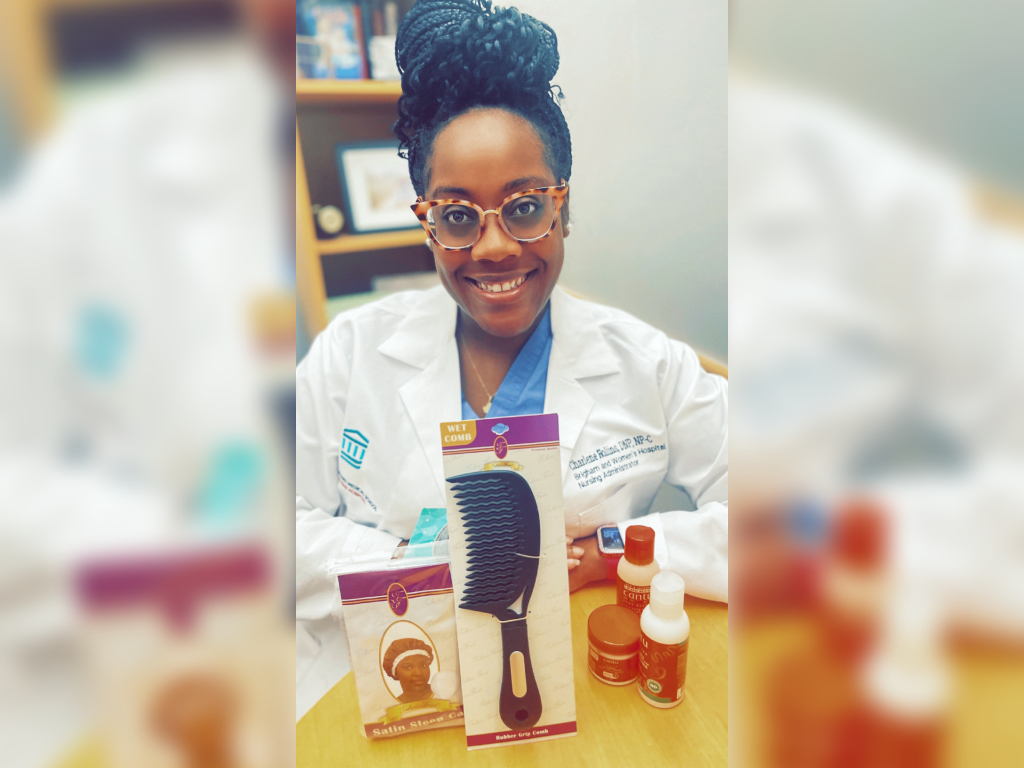
Nursing administrator Charlene Hollins displays some of the new haircare and grooming items available for patients with curly and coily hair.
Charlene Hollins, DNP, APRN, FNP-C, remembers the day she responded to a patient’s request for a comb. Hollins, a nursing administrator and off-shift nursing director, went to the floor’s supply cabinet to retrieve the only such item available: a thin, plastic, fine-tooth comb.
“The patient literally laughed at me when she saw it,” Hollins recalled. “She said, ‘I can’t use that. Is there anything else I can put through my hair?’”
The patient was a woman of color with tightly coiled hair. Hollins, who is Black, was not surprised by the patient’s reaction. She understood it, and it galvanized her.
“That experience stayed with me,” Hollins said. “Why don’t we have products to be inclusive of everyone’s hair?”
Grooming and haircare products found in most hospital supply cabinets throughout the country are not suitable for very curly or coily hair, which has unique needs due to the shape and the texture of the strands. Curls and coils are more porous and fragile than straight or wavy hair. As a result, people with these hair textures need thick, moisturizing styling products and other protective items to prevent hair from breaking, tangling or matting. Similarly, mainstream combs or hairbrushes are either ineffective on curly and coily hair or can damage it.
So, when Hollins later learned from colleagues in the Department of Quality and Safety about an Iowa hospital that had begun stocking grooming supplies for textured hair, she immediately thought back to that patient interaction.
“I said, ‘Let’s get started,’” she said. “The Brigham is United Against Racism, right? This is one way we can demonstrate that we are following through on our statement.”
That conversation sparked a collaboration between Nursing, Quality and Safety, Materials Management and Infection Control to launch the “Inclusive Grooming Products Pilot” earlier this spring. Inpatient units participating in the pilot have been supplied with sulfate-free shampoo, conditioner, leave-in styling cream, satin bonnets, plastic shower caps and wide-tooth wet combs.
“Supplying culturally appropriate haircare and grooming products is a simple but powerful way of prioritizing the dignity, respect and experience of people from historically marginalized populations,” said hospitalist Esteban Gershanik, MD, MPH, MMSc, who co-chairs the Equity Domain Team, a forum for Quality and Safety leaders to collaborate with clinical units and service lines to advance racial justice and equity in care delivery. “These are little things we can do that go a long way in making patients feel centered and seen.”
Already, the program has sparked positive feedback from patients. “I applaud the effort for the inclusion of all people and ethnicities,” one patient wrote in a feedback survey. Another noted, “Works very well on my curly hair. It is extremely pleasant to see these hair products in the hospital.”
Thoughtfully designed

From left: Charlene Hollins and Brittany Frederick lead a workshop on the pilot.
In addition to Hollins and Gershanik, the project is led by Regan Marsh, MD, MPH, Celene Wong, MHA, and Brittany Frederick, MA, with significant collaboration with Materials Management.
The pilot is active in the General Medicine Service units in the Braunwald Tower — 12AB, 14ABCD, 15BCD and 16AB — and in the Antepartum and Postpartum units in the Connors Center for Women and Newborns. During the pilot phase, the project team is administering surveys to patients to receive their feedback, as well as working closely with nurses to ensure an optimal workflow, with hopes to spread to other services and throughout the hospital.
Prior to this effort, Hollins said she often saw patients of color bringing their own haircare supplies from home or asking a loved one to purchase them — something most white patients would not need to do. It’s not a matter of vanity, but basic hygiene needs due to differences in hair types.
“We all need to groom ourselves every day, and it’s part of patient care,” Hollins said. “There’s hope that people will start to understand that there are differences in this world — whether they be medical, cultural or racial — and we need to respect them.”
From idea to implementation

A flyer details available products in participating units. (Click to enlarge.)
Bringing the project from idea to implementation was no small feat, however. After obtaining support from senior nursing leaders, the team worked closely with the New Product Approval Committee, Materials Management and Brigham Dermatology to identify products that would be high quality, safe and cost effective.
From there, the team met with colleagues at other institutions, including Massachusetts General Hospital and Boston Children’s Hospital, who have undertaken similar initiatives to learn from their experiences. Then, the team conducted training sessions for nurses in participating units. In all, it took about a year to come to fruition, partly due to product backorders.
“Systems don’t change easily, but it felt like everywhere we went, everyone said, ‘Yes, yes, yes,’” Gershanik said.
As part of the project’s equity-informed approach, the team wanted to avoid putting nurses in a position where they would have to use their personal judgment when deciding whether to offer the new supplies to a given patient — a recipe for implicit bias.
Instead, participating units have flyers available listing the haircare and grooming products for curly, coily, dry or chemically treated hair. Upon admission, every patient is asked what they need for their bedside basin in terms of hygiene and grooming, and their nurse or patient care associate stocks it accordingly.
While providing education to nurse colleagues, Hollins said there was visible enthusiasm among staff in the pilot units.
“We explained that this isn’t ‘in addition to.’ They already do this for patients. It’s just a different approach,” she said. “All the nurses were excited to get started and felt it was best for our patients. So many said to me, ‘Our patients have been asking for these products.’”
5 Responses to “The hair necessities: BWH introduces grooming products for patients with curly and coily hair textures”
This is welcoming news for me. I’ve brought my own hair products and tools for patients that have a longer stay here at the hospital.
Great job identifying some that seems small but yet very impactful.
It’s about time!
So many patients will be impacted by this introduction of these items. I applaud Nursing Administrator Charlene Hollins for her efforts and the community that will benefit from her commitment to patients.
This is wonderful to see
Comments are closed.