
‘The room shines when Dr. Nour walks in’: African Women’s Health Center marks 25 years of compassionate, culturally sensitive care

Nawal Nour warmly greets longtime patient, colleague and friend Layla Guled at the African Women’s Health Center.
Nawal Nour, MD, MPH, MBA, chair of the Department of Obstetrics and Gynecology, was completing her OB-GYN residency at the Brigham in the late 1990s when she started to notice a trend. More and more, patients in her clinic came from countries such as Ethiopia, Nigeria, Somalia and her own homeland, Sudan.
They arrived because they had heard — from their peers or doctors — that there was a Sudanese OB-GYN who understood how to care for women like them. That is, women who have undergone female genital cutting. A cultural practice in parts of Africa, Asia and the Middle East, female genital cutting involves partial or total removal of external female genitalia, usually at a young age. It is also referred to as female genital mutilation and female circumcision.
“By word of mouth, I created this panel of patients who came from that region of the world,” Nour said.
One of those patients was Layla Guled, who had fled civil war in Somalia in 1995. At the time, she was a young mother of three. During her first OB-GYN visit in the United States, Guled informed her doctor prior to the exam that she had been circumcised.
“She didn’t understand what I was talking about. She just had me go up on the table and opened my legs. It felt like a violation,” Guled said. “When she saw me, she was like, ‘Oh my God, what happened to you?’”
The tone was not one of concern. It was judgment. Questions about her health that Guled raised during the appointment were never addressed.
Guled was reluctant to repeat the experience, but she needed care. By then, she was working as a Somali and Arabic interpreter at the Brigham, and she had an opportunity to work with an OB-GYN resident on several cases. She seemed kind, Guled thought. She took a leap of faith and made an appointment with Nour, not even realizing she was African, too.
The visit was completely uneventful. “Dr. Nour said to me, ‘OK, everything looks good,’” Guled recalled. And just like that, it was over. Guled was in disbelief. “I was like, what is she talking about? I was worried she was going to treat me like the other doctor,” she said.
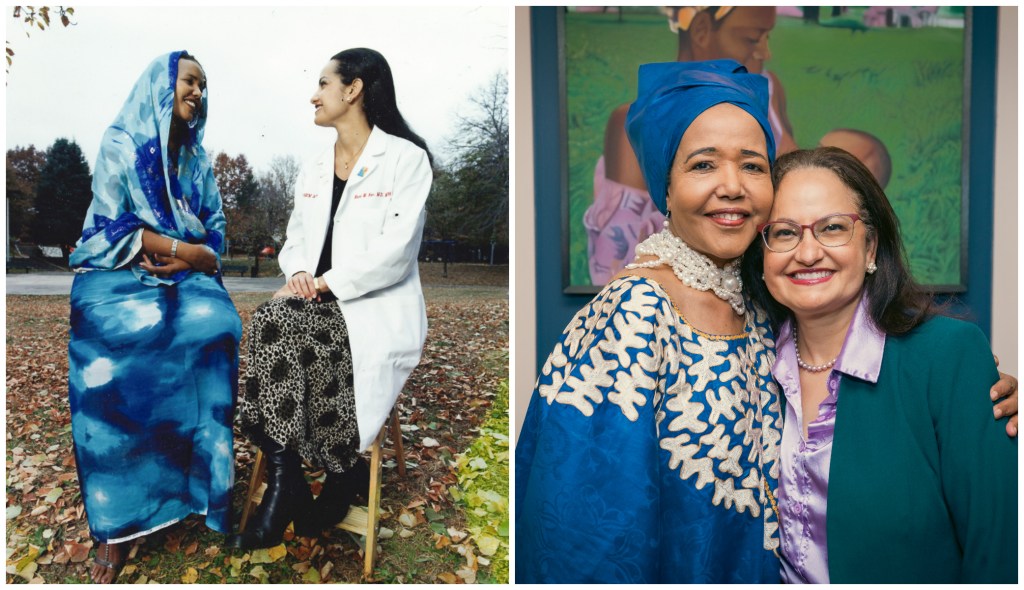
Left photo: Guled and Nour celebrate the launch of the African Women’s Health Center in 1999. Right photo: Today, they remain close friends and colleagues with a shared passion for ending the practice of female genital cutting.
Around the same time that Nour started seeing an influx of patients like Guled, she took a trip to visit her mother in London. With these patient interactions fresh in her mind, Nour sought out an opportunity to shadow a midwife at Northwick Park Hospital, which had established the African Well Women’s Clinic to provide specialized care to women who have undergone female genital cutting.
“It was so inspirational to me to know that there was a model that worked, and, in fact, I was already doing it,” Nour said. “I just hadn’t given it a name.”
That would soon change. After making her case to hospital leaders, Nour, a newly minted attending OB-GYN by then, founded the African Women’s Health Center at Brigham and Women’s Hospital in July 1999. It was the first clinic of its kind in the United States.
The center marks its 25th anniversary this year. Over its quarter-century of existence, it has delivered high-quality, compassionate and culturally sensitive care to thousands of women and trained approximately 250 physicians to carry out that same mission.
Nour, who has made it her life’s work to end female genital cutting, feels torn about reaching this milestone.
“I have mixed feelings. I had built this center with the goal that it would no longer be necessary in time. The fact that we are still in existence and patients are coming means there is still work to be done,” she said. “At the same time, I’m proud that we have educated so many people, which means our patients don’t have just one place to go. I have former trainees from all over the country who contact me to say, ‘If it had not been for you, I wouldn’t have known how to take care of this patient.’”
‘I want that word to disappear’
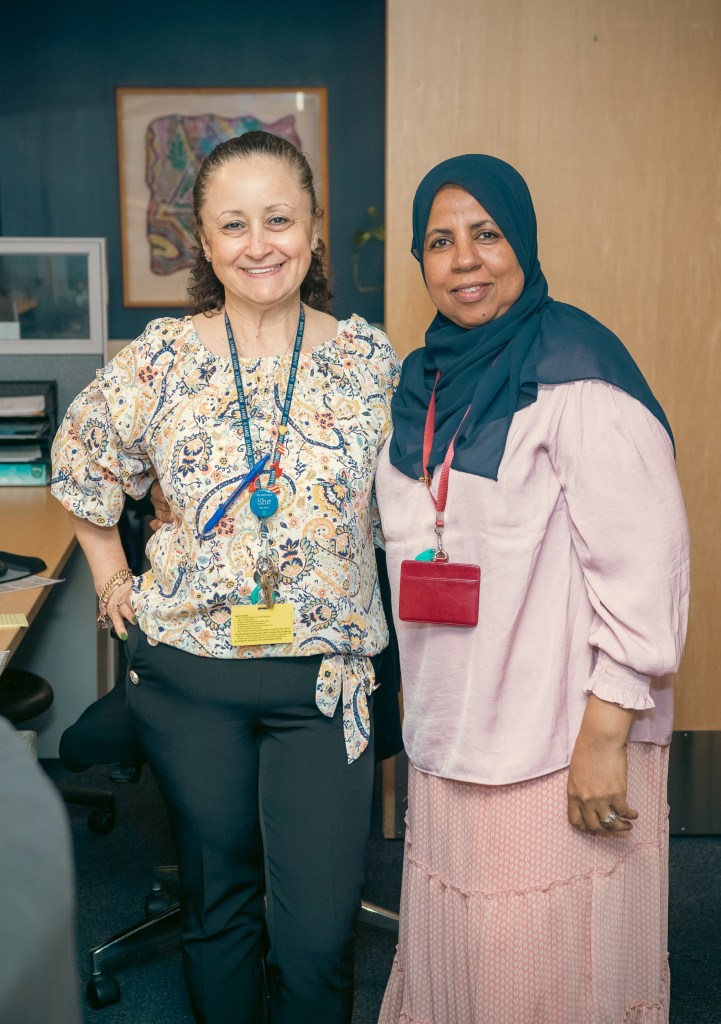
From left: Grisel Cartagena and Setenur Adem are among the staff who greet patients visiting the center.
Female genital cutting has no medical basis and no health benefits. It has a long list of associated risks, including physical complications related to urination, menstruation, fertility and childbirth, as well as harmful effects on psychological health and sexual function. It is performed on young girls from infancy to age 15. It is widely regarded as a human rights violation and has been criminalized in most countries.
The practice is not rooted in religion, but rather custom. Among cultures that still perform female genital cutting, it is regarded as a rite of chastity needed for social acceptance and marriageability.
“I don’t want any girl to go through what I’ve been through,” said Guled, who continues to receive her care at the center, in addition to serving as a Somali interpreter for other patients there. “I can say our mothers didn’t know better, but I hope we have a generation that doesn’t talk about circumcision anymore. I want that word to disappear.”
Although the practice is declining, it is far from eradicated. According to the World Health Organization, an estimated 230 million girls and women alive today have undergone female genital cutting.
“Even early on in our work, many of my patients were relieved that there was a law in the U.S. that made female genital cutting illegal,” Nour said. “In certain parts of Africa — including the last time I went to Khartoum, where I was born — I can hear that there is a change in the narrative. Countries such as Senegal are doing a great job of trying to stop the practice. However, there are other places where it is still so deeply ingrained in the culture that it almost seems unfathomable to not cut your daughter.”
Providing a haven
Housed in the Connors Center for Women and Newborns, the African Women’s Health Center holds a weekly clinic for routine obstetric and gynecological care — everything from pap smears and prenatal visits to surgical reconstruction — as well as medical needs more directly related to female genital cutting.
More than just a clinic, however, the center is also a community closely bonded by shared experiences and cultural understanding.
“When patients walk into the clinic, they feel like family. Dr. Nour says, ‘How are you? Salam alaykum,’ and the patient relaxes right away. The trust starts with that greeting and respecting the culture,” Guled said. “The room shines when Dr. Nour walks in because she’s not shaming her patients. She doesn’t see them as ‘there is something wrong with you.’ She’s there to help — that’s it.”
Although Nour continues to hope that the day will soon come when the center is no longer needed, she maintains an abiding commitment to its mission and her patients.
“When I became chair, I knew there were things I could no longer do. This was the only thing I would not give up,” she said. “It’s what grounds me and gives me joy in the midst of really tough weeks. I always look forward to talking to my patients. I learn so much from them, and they inspire me.”
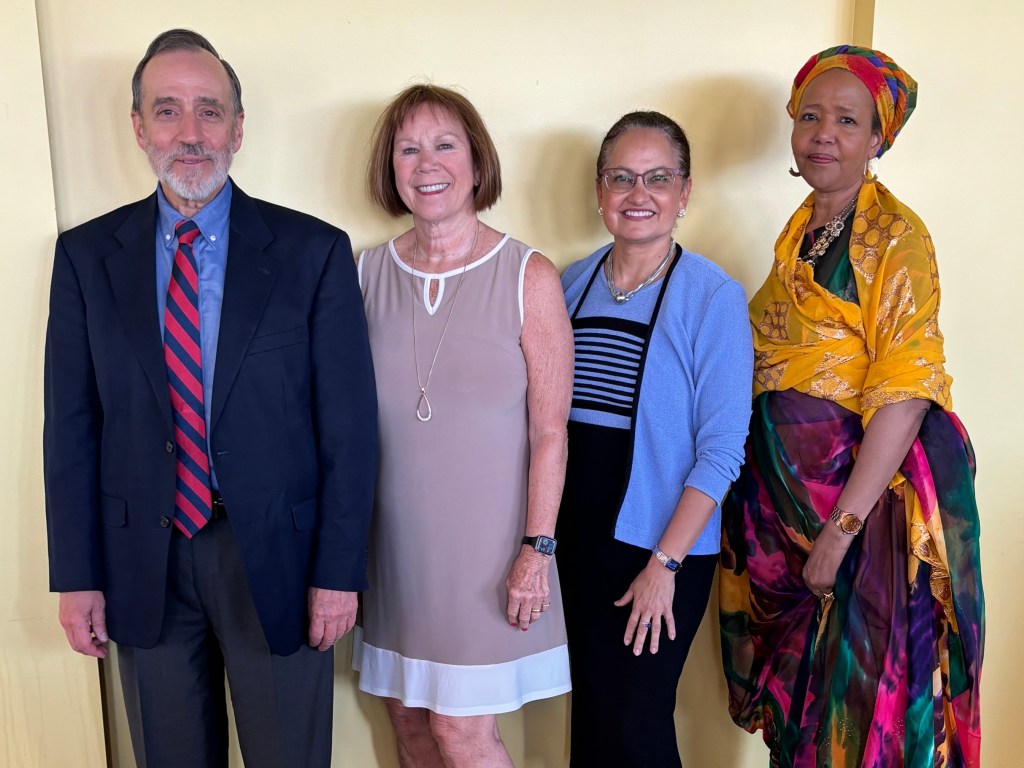
From left: Robert Barbieri, Betty Fenton-Diggins, Nawal Nour and Layla Guled reunite at a celebration commemorating the center’s 25th anniversary. Barbieri was OB-GYN chair at the time of the center’s founding and an enthusiastic supporter; Fenton-Diggins, now retired, was a longtime nurse there.
Leave a Reply