
In Memoriam: Howard H. Hiatt, MD, Division of Global Health Equity
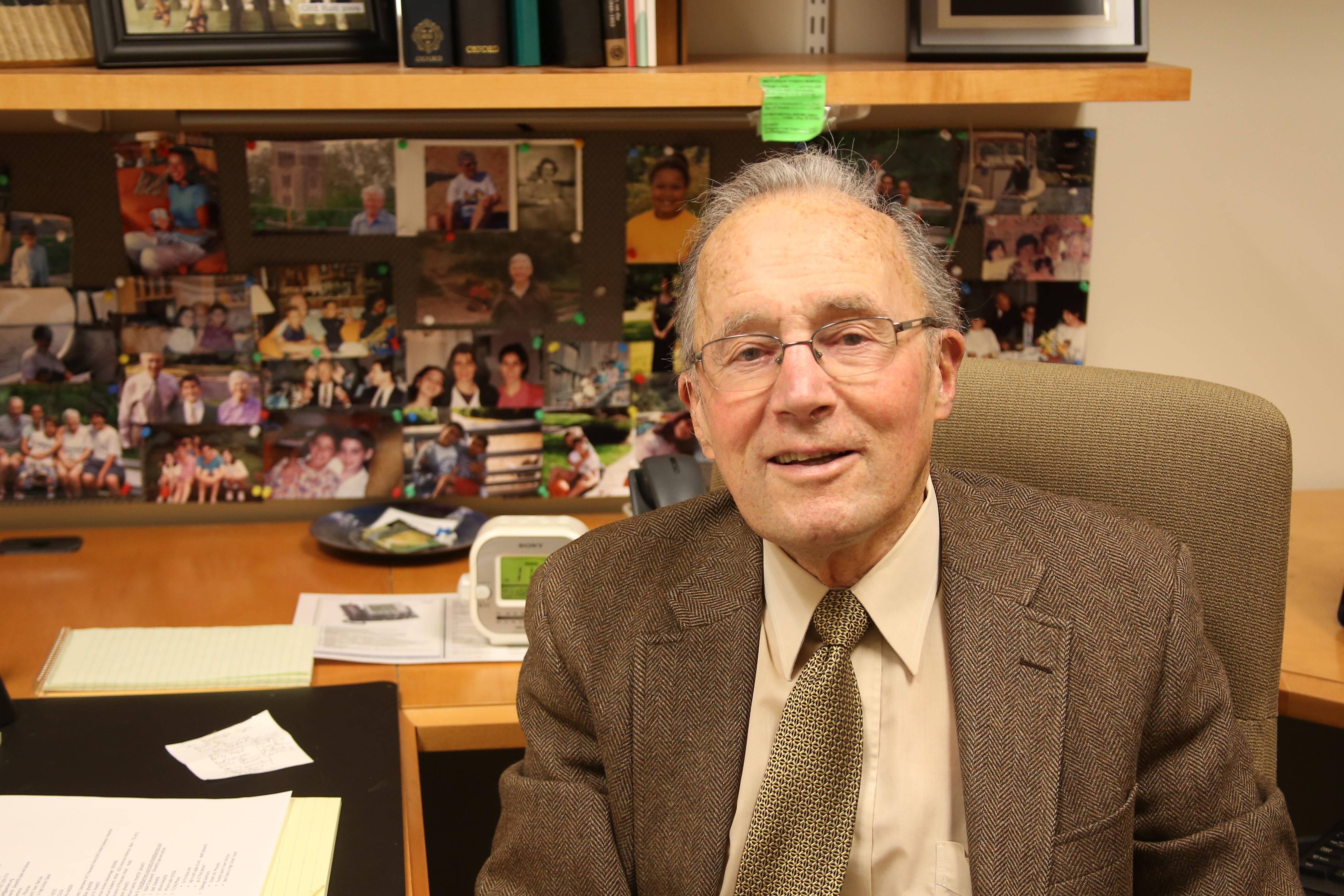
Brigham and Women’s Hospital mourns the loss of Howard H. Hiatt, MD, co-founder and former associate chief of the Division of Global Health Equity, who reshaped the fields of public health and health equity through his prolific mentorship and passion for social justice over a seven-decade career. He died on March 2 at the age of 98.
Despite having multiple seminal achievements, Dr. Hiatt was least comfortable talking about his own record, which included contributing to the Nobel Prize-winning discovery of messenger RNA, a 12-year deanship of one of the world’s top public health schools and helping influence President Ronald Reagan to limit the country’s nuclear armament. Guiding, supporting and advocating for the next generation of physicians, scientists and public health leaders brought him far greater joy.
“Howard was one of the rare mentors who not only could offer wise advice on your career but who also genuinely cared about who you were as a person,” said Joseph Rhatigan, MD, chief of the Division of Global Health Equity.
From a young age, Dr. Hiatt experienced firsthand how transformative a caring mentor can be. After graduating from Harvard Medical School in 1948, he was taken under the wing of National Institutes of Health (NIH) biochemist Bernard Horecker, PhD. Dr. Hiatt never forgot the kindness of his first mentor — a framed, black-and-white photo of Horecker adorned his office at One Brigham Circle — and he made it his life’s work to repay the favor.
“Howard Hiatt was the mentor we all aspired to be,” said longtime friend and colleague Marshall A. Wolf, MD, MACP, emeritus vice chairman for Medical Education.
That commitment was immortalized in 2004 with the establishment of the Doris and Howard Hiatt Residency in Global Health Equity at the Brigham, named in honor of Dr. Hiatt and his wife. The four-year program, which has graduated approximately 70 physicians since its founding, combines rigorous training in internal medicine with the advanced study of public health to equip physicians with the skills necessary to improve the health of the world’s most impoverished people.
Among those who experienced Dr. Hiatt’s devotion to mentorship is Bram Wispelwey, MD, MS, MPH, a physician in Global Health Equity, co-director of The Palestine Program for Health and Human Rights at Harvard’s FXB Center for Health and Human Rights, and 2018 graduate of the Hiatt Residency in Global Health Equity.
“Howard’s gift as a mentor was to be even more committed than you to your own success,” Wispelwey said. “He was always curious, asking the most thoughtful questions and remembering the important personal details. Without my realizing it, he would locate challenging barriers to a professional goal and then remove them, sometimes secretly and invariably without taking credit.”
One example of that generosity and humility remains etched in memory for Wispelwey.
“When I was discussing a program we were hoping to establish at the Harvard FXB Center, I only found out from someone later that Howard was actively helping make it a reality behind the scenes,” he said. “Once I found out, I brought it up with him to say thank you, and he gave this quick boyish smile and looked away, immediately changing the subject to focus on me and my family. That was Howard.”
Similarly, longtime mentee and colleague Sonya Shin, MD, MPH, an associate physician in the Division of Global Health Equity and consulting physician at Gallup Indian Medical Center in Gallup, N.M., fondly recalled how Dr. Hiatt “expected more from me than I did from myself.”
“I suspect his biggest skill was seeing the full, unrealized potential of every person and helping us see it within ourselves,” she said. “He was genuinely boundless in his caring for others. At each of our meetings, Howard would inquire about my family, with encyclopedic memory of each of my children. He would ask about my husband, my parents. He would skillfully deflect any attempt I made to ask about his own well-being, saying something like, ‘Howard is fine, but more importantly, how is Sonya?’”
With Dr. Hiatt’s encouragement and backing, Shin founded the Community Outreach and Patient Empowerment (COPE) Program to improve the health of people in Navajo Nation. Since the program’s 2009 launch to today, Dr. Hiatt remained an enthusiastic champion of COPE, which Shin says was built on earlier work he did with the late Phyllis Jen, MD, who together built trust with Indigenous populations and laid the foundation for a long-term partnership.
For nearly two decades, Dr. Hiatt continued to travel to New Mexico to support clinicians and patients in Navajo Nation — a reflection of his unrelenting commitment to building a more just world for marginalized populations, Shin noted.
“Alongside his limitless generosity and humanity, Howard also had a steel core: He was unyielding when it came to doing the right thing. He did not tolerate questionable behavior, and he showed astounding perseverance in his mission to advance health equity,” she said. “Despite his longevity or perhaps because of it, Howard — more than almost any other person I know — lived with the urgency and presence that each day deserves.”
Soon after starting his medical and research career, Dr. Hiatt followed his interest in molecular biology to the Pasteur Institute in Paris, joining the team that would prove the existence and function of messenger RNA. In 1963, he returned to Boston to become physician-in-chief at Beth Israel Hospital, where he helped to start its oncology program, and in 1972 was appointed dean of the Harvard School of Public Health. As dean, Dr. Hiatt led an era of transformation in the school’s curricula to broaden its work into more interdisciplinary studies.
“When Dr. Hiatt completed his term as dean of the Harvard School of Public Health, I recruited him to join the Department of Medicine at BWH,” remembered Eugene Braunwald, MD, former chair of the Department of Medicine and founding chair of the Thrombolysis in Myocardial Infarction (TIMI) Study Group. “Among his many contributions to the institution, together with Dr. Lee Goldman, he developed a unique Research Training Program in Clinical Effectiveness, one of the first and most important programs that prepared post-residency trainees for a career in the conduct of rigorous clinical trials.”
In 2001, Dr. Hiatt helped launch the Division of Social Medicine and Health Inequalities (later renamed Global Health Equity) with his most promising mentees: Paul Farmer, MD, PhD, and Jim Yong Kim, MD, PhD, co-founders of Partners In Health. Kim became the division’s founding chief, and Dr. Farmer later led the division for over a decade until his sudden death in 2022.
The three of them, along with Wolf, then serving as director of the Internal Medicine Residency Program, and Joel Katz, MD, later the successor to that program, developed and launched the Global Health Equity residency three years later. The program was among the first of its kind in the nation.
“Both of these programs — the Research Training Program in Clinical Effectiveness and the Global Health Residency — were enthusiastically received by our trainees, many of whom became leaders in their respective fields,” Braunwald added. “These programs have spread to other institutions, where they also enjoyed success.”
Dr. Hiatt is predeceased by his wife, Doris, and son Fred Hiatt. He is survived by his son Jonathan; his daughter, Deborah; his brother Arnold Hiatt; eight grandchildren; four great-grandchildren; and his longtime companion, Penny Janeway.