
By Elevating Narratives of Structural Racism, Brigham Researchers Work to Illuminate the Path to Health Equity
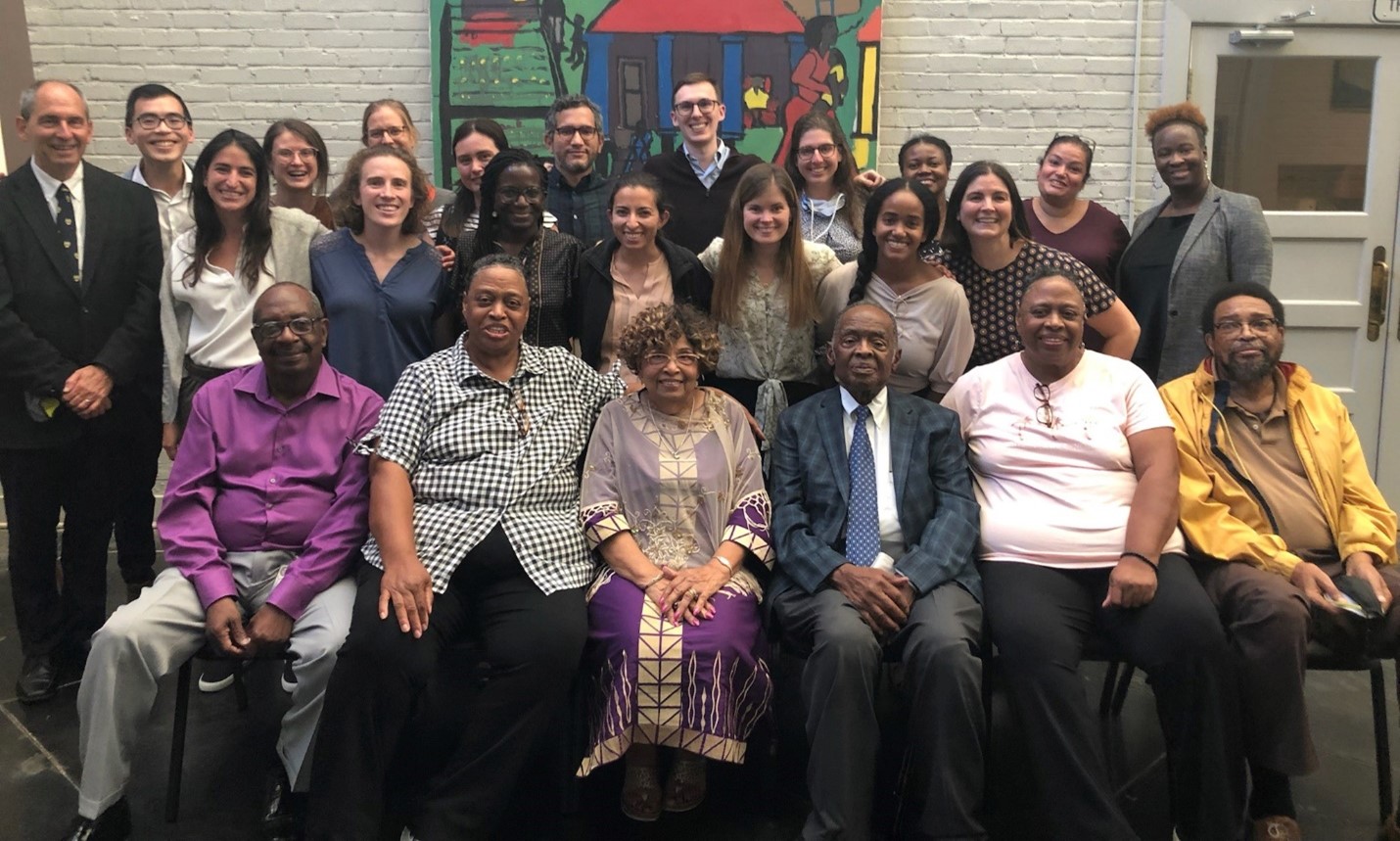
A September 2022 trip to Jackson, Miss., to hear from the founders of the community health center movement inspired Brigham researchers to launch Our Health Stories, a project dedicated to chronicling accounts of efforts to eliminate structural racism in health care. Civil Rights leaders and community activists (front row, from left: Hezekiah Watkins, Linda Willis, Flonzie Brown Wright, Dr. Robert Smith, Brinda Willis and Frank Figgers) spoke with Brigham residents and staff about their experiences challenging segregation in Mississippi.
Since their inception in the 1960s, community health centers have played an integral part in advancing health equity throughout the country by embedding high-quality, affordable care into historically underserved communities. However, despite the wide reach and importance of community health centers, many clinicians are unaware of their history and impact — a fact that Brigham health equity researcher and hospitalist Cheryl Clark, MD, ScD, is eager to change.
In partnership with civil rights and community health center leaders, Clark and colleagues developed the Our Health Stories project, which seeks to chronicle experiences of resistance to structural racism in health care by disseminating the stories of community health center leaders to members of the public and medical professionals across the U.S.
“This is a critical time to center stories of courage and activism and to build more resources so that clinicians can envision what is possible,” said Clark, associate chief of the Division of General Internal Medicine and Primary Care and executive director of the Massachusetts League of Community Health Centers’ Institute for Health Equity Research, Evaluation and Policy. “So, in many ways, Our Health Stories is a platform for exchanging knowledge about our history and the current movements around health equity, as well as the experience of patients and regular people who have encountered barriers to equitable care.”
The history of community health centers, also known as federally qualified health centers, is at the heart of the project.
The nation’s first two community health centers emerged in 1965 to address unjust gaps in health care within poor communities, predominantly occupied by people of color, in Boston’s Dorchester neighborhood and a rural Mississippi town, Mound Bayou. One of the founding principles of the movement is that all patients deserve access to high-quality and comprehensive care, regardless of their ability to pay. Today, there are over 1,400 community health centers across the country— including the Brigham’s Southern Jamaica Plain Health Center and Brookside Community Health Center — and these centers remain at the forefront of efforts to reduce barriers to care, focus on social determinants of health and champion social justice issues.
For Clark, there is a direct line between understanding this heritage and achieving health equity today.
“Community health centers really have been the light that have shown us how to address social determinants of health,” she said. “What we now call community health workers were embedded in the model. What grew out of a movement to demand health care and human rights for African Americans has wound up being helpful for everybody. They created the infrastructure for how you take care of a population.”
A Meaningful Meeting
The idea for Our Health Stories came from a September 2022 trip to Jackson, Miss., for faculty, residents and staff in the Department of Medicine’s Leadership for Health Equity Pathway to learn about the origins of the community health center movement. Clark, who attended the trip, found herself seated at a lecture from Robert Smith, MD, a principal founder of the community health center model, as he shared his experiences with the group.
“He had to push through being arrested and put in the back of a police car just because he wanted to provide care to African Americans,” Clark said, “As I talked to colleagues, it was apparent that many clinicians had not heard that story, even though he’s written about it and has published journal articles about what he’s experienced. This is a critical part of medical education that is missing.”
After their initial meeting, Smith and Clark collaborated to re-document his story together and to make it a broader resource for other clinicians. From there, Our Health Stories flourished.
While the project has been a rewarding to work on, Clark acknowledged it has also brought up many emotions.
“There was a mix of inspiration and pain in hearing the stories,” she said. “The pain was all the harassment and danger that people had to go through just to advocate for others to even see a physician. But for me, what has been so inspiring is what they were able to accomplish: Now, community health centers serve more than 30 million people across the country.”
Callie Gu, a health equity research assistant in General Internal Medicine and Primary Care, shared similar takeaways after conducting several of the interviews for Our Health Stories.
“It was really inspiring to interview these Civil Rights leaders and hear about their work,” Gu said. “It brings a lot of hope for the next generation of physicians to reimagine health care.”
Expanding the Reach
A central part of Our Health Stories was not only documenting the stories of Civil Rights health leaders but also seeing how these accounts can help inform the work doctors do at the Brigham and beyond.
“It has been so important, I think, as internal medicine physicians, to make sure that the care we provide has equity at the center,” said Clark, who expressed her gratitude to the Brigham’s Department of Medicine Internal Medicine Residency Program for recognizing this must be a priority in medicine.
In the future, Clark wants to build on the momentum of Our Health Stories by partnering with medical education organizations and incorporating these resources in their curriculum.
“All physicians, we hope, will avail themselves of this resource and understand what it takes to provide the foundation for health equity in the U.S.,” Clark said. “We want everybody to have access to these stories.”
To learn more about Our Health Stories and read the narratives of Civil Rights health leaders, visit www.ourhealthstories.net.