
Amid Statewide Housing Crisis, Brigham Housing Intervention Program Transforms Lives — One Apartment at a Time

Gerald Trusty relaxes in his new Charlestown apartment, which he obtained with the support of the Brigham’s housing intervention program after the building where he previously rented was sold.
Gerald Trusty, 64, had been living in the same Dorchester apartment for 20 years. It wasn’t a palace, but it was home.
“I was really comfortable there,” he said.
For Trusty, a crucial feature of the apartment was its first-floor location in a two-family building. He has a chronic lung disease and requires supplemental oxygen therapy 24 hours a day — a condition likely caused by his former profession as a chimney sweeper — and has difficulty using stairs. He also has other serious health concerns, including pulmonary hypertension and diabetes.
In his two decades at the Woodrow Avenue apartment, Trusty had lived under three different landlords. Then, one day in July 2021, his latest landlord informed him she was going to sell the building. At first, he wasn’t too alarmed. Each time the property’s ownership had changed hands, Trusty was able to negotiate a new tenancy agreement. He prided himself on being a responsible tenant, and his landlord assured him that she would find a buyer who would allow him to stay.
But things worked out much differently this time. Two weeks after the building sold in spring 2022, Trusty was stunned to receive a “notice to quit,” a legal document ending a tenancy agreement, from the new owner. Although it doesn’t signify an eviction, it can precede one if the tenant refuses to leave.
The timing couldn’t have been worse: Rents across the Boston area were soaring to historic highs, competition for apartments was fierce and Trusty was on a fixed income. His medical needs limited his choices for housing even further.
“I got into a panic. I’m thinking, what am I going to do?” he recalled. “The new owner said I could come back after he renovated it, but the rent would be tripled. I couldn’t afford it, and the rest of the market was blowing up. I couldn’t find something in my range that I could live in comfortably.”
It was then that a friend suggested he tell his doctor about his circumstances. Trusty was skeptical.
“I said, ‘What the heck can a doctor do for me in this situation?’” he remembered.
A whole lot, it turned out.
A New Chapter
After calling the Brigham’s Phyllis Jen Center for Primary Care, where he typically sees internist Juan Ramirez, MD, Trusty was referred to the Brigham’s housing intervention program, which works to identify and support patients who are at risk of eviction, living in unsafe or unhealthy housing conditions, or unhoused.
Launched in 2018, the program is part of a larger strategy in Brigham Primary Care to address social determinants of health (SDoH), a term for nonmedical conditions that influence a person’s health, such as housing, education, employment and transportation access.
With intensive support from the program, Trusty was able to remain in his Dorchester apartment while completing multiple applications for public and private housing, including several affordable housing lotteries. He was overcome with relief when he learned one of his lottery applications was selected. This past August, he moved into a gleaming new development in Charlestown.
“I love it. Everything here is brand new — the wood floors, stainless steel appliances, kitchen counters, everything. It’s so much better and has so much more space,” he said. “I’m on the second floor, but there are elevators, so I can just use my mobile power scooter to get wherever I need to go without any problems. It’s well set up for my situation.”
Bridget Faison, housing advocacy supervisor in Primary Care’s Social Care Team, worked closely with Trusty to help him navigate a complex web of housing and legal services to remain housed while he found a suitable home.

“I never in my life thought the hospital has that much power to help you out in these situations,” says Gerald Trusty, who looks forward to celebrating his first Christmas in his new apartment.
“It’s important to me that I educate patients and empower them to be independent. If you can teach someone how to take care of themselves in this system, you’ve given them a whole lot more than housing,” she said. “It’s rewarding to see my patient’s face light up when they say to me, ‘Bridget, I completed an application and didn’t need you this time — but can you look at it?’”
While similar programs across the country target patients who are already unhoused, the Brigham’s approach stands apart with its sharp focus on prevention, said primary care provider MaryCatherine Arbour, MD, MPH, medical director of the Social Care Team, a multidisciplinary group in Primary Care that seeks to address SDoH through initiatives like the housing intervention program.
“Only 9 percent of patients who present with housing needs are homeless, and by the time they are homeless, their housing options are very limited,” she said. “Depending on the circumstances, when someone gets evicted, they may not be eligible for subsidized housing for two years, so eviction prevention is a huge area of focus for us and pretty unique in this space.”
Preventive Care in Action
Amid the current housing crisis in Massachusetts, such outcomes are hard won. They reflect the tireless commitment of the Social Care Team, whose community resource specialists, community health workers and housing advocates collaborate with clinical staff to help vulnerable patients with SDoH-related needs.
The Brigham’s 15 primary care sites all conduct SDoH screening annually for every MassHealth patient. Four of those practices have expanded the screening to all primary care patients.
Eligible patients are asked questions like “Do you have trouble paying your heating or electricity bill?” and “What is your housing situation today?” About half of patients screen “positive” for at least one SDoH question, meaning their response indicates they might be facing a nonmedical issue that could affect their health.
The state’s housing crisis is acutely evident in these screenings. One in three Brigham primary care patients who have been surveyed say they have housing needs. The burden is also shouldered inequitably, with Black and Hispanic patients being far more likely than white patients to report housing insecurity.
During the pandemic, the number of Brigham primary care patients referred to the Social Care Team increased tenfold, from 20 per month in 2020 to 200 per month in 2022. In 2023, it grew to 350 referrals per month.
Surging rents are only part of the story. Subsidized housing waitlists have ballooned as well. Since 2016, it has taken an average of three years for someone to come off the waitlist for subsidized housing in Massachusetts, according to HousingWorks, a Boston-based organization that tracks subsidized housing availability. Compare that to the 1990s, when the average wait for public housing placement was closer to six months.
“There is an avalanche of need, but there just aren’t enough resources,” Arbour said. “I treat patients with really complex medical issues, and housing is still the most complicated thing that I do.”
The team’s five housing advocates use a triage approach to sustainably manage what would otherwise be a crushing caseload. Referrals first go to community resource specialists, a larger group, who work to gather more information about the patient’s circumstances. Patients who are stably housed but may not be an in ideal situation, such as temporarily living with a relative, receive guidance on which resources and services are available to address their needs.
Patients who are at highest risk — such as someone facing imminent eviction — are prioritized to receive one-on-one, longer-term support from a housing advocate, who works directly with them until they are stably housed.
The specialized team works closely with patients to help them search and apply for housing, request reasonable accommodations due to medical needs, negotiate with landlords and building management, tour and evaluate properties for quality and safety, conduct mock interviews, learn how to budget and improve their credit score, and more. The program also relies on two medical-legal partnerships: one with MLPB, which conducts case reviews with Social Care Team members and provides expert guidance about patients’ rights and system responsibilities, and another with Harvard Law School’s Legal Services Center to provide patients free and qualified legal representation in housing court.
Making Gains
While apartment hunting may seem outside the scope of medicine, stable housing and the ability to achieve good health are closely linked, Arbour said.
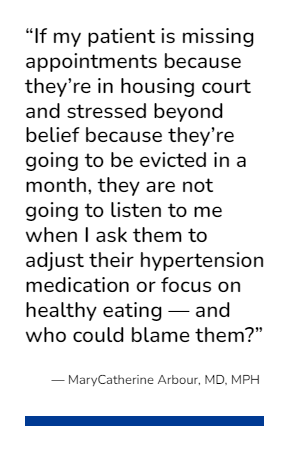
“If people don’t have a safe and healthy place to live, there’s no way they can effectively engage in care,” Arbour said. “If my patient is missing appointments because they’re in housing court and stressed beyond belief because they’re going to be evicted in a month, they are not going to listen to me when I ask them to adjust their hypertension medication or focus on healthy eating — and who could blame them?”
Arbour and her team have measured some of these outcomes. One year after being enrolled in the program, participating patients had about 2.5 fewer primary care visits per year — a trend driven by reduced need for social work, behavioral health, psychiatry and urgent care visits.
The team’s analyses haven’t shown a connection between housing stability and other health-related improvements, such as reduced emergency department visits or better blood pressure control. It may be that one year is too short of a window to see a difference in these areas, Arbour said, acknowledging more study is needed.
Anecdotally, participating patients have expressed that having stable, safe housing has improved their physical and mental health. For some patients, their housing advocate’s unwavering support was a powerful force in itself. In one interview, a patient recalled how she was “tapped out” after struggling and failing to find housing. Her housing advocate encouraged her to keep going.
“She didn’t let me give up. She pressed. I pressed. And together, we definitely made them diamonds happen in my life again … and it all was because this woman helped me,” the patient said. “I love my hospital…. I’m a full-fledged, hardcore, dedicated patient.’”
For Trusty, who looks forward to celebrating his first Christmas in his Charlestown apartment, the support he received from Faison and the housing intervention program has been nothing short of a blessing in his life.
“To be honest, I don’t know where I would be without Bridget — probably in the streets,” he said. “I never in my life thought the hospital has that much power to help you out in these situations, and I am very grateful for all they did for me.”
One Response to “Amid Statewide Housing Crisis, Brigham Housing Intervention Program Transforms Lives — One Apartment at a Time”
How do BWH clinicians access this housing program for patients?
Comments are closed.