


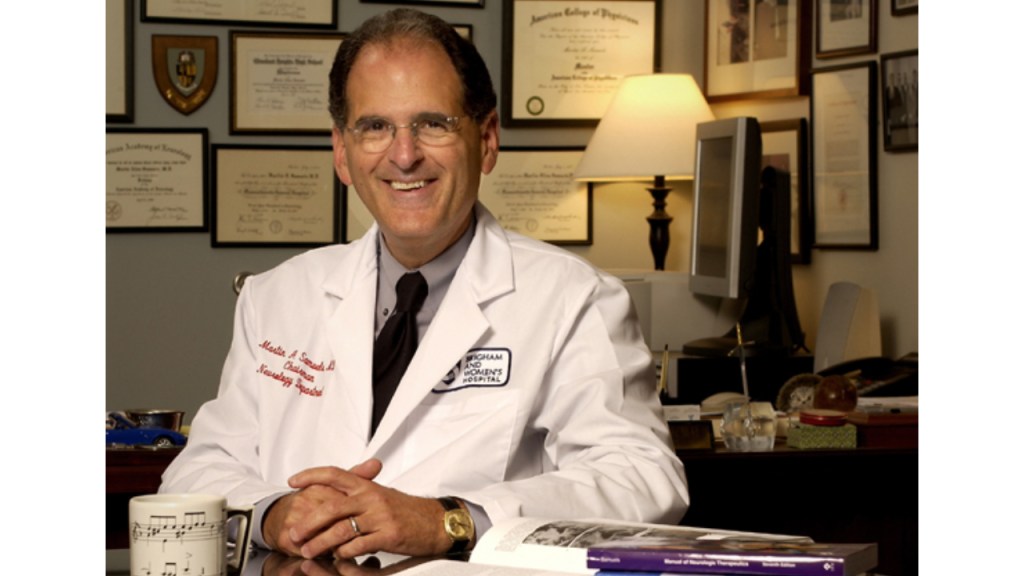


A member of the Brigham community for more than 40 years, Dr. Samuels was recruited from the West Roxbury Veterans Administration Medical Center, where he started the neurology service in 1988, to build a new Division of Neurology at Brigham and Women’s Hospital. In 1994, this division was elevated to department status, and he formally became its founding chair. Over the next three decades, Dr. Samuels transformed what was once a small division within the Department of Medicine and catapulted it into one of the world’s premier clinical, research, and teaching programs in academic neurology.
“Marty was the founder of the department and its soul. He absolutely loved being a neurologist and was passionate about teaching the next generation, making sure we all knew the history of the department, honoring all his previous teachers and mentors, and attracting the most amazing, brilliant faculty and residents,” said longtime colleague Barbara Dworetzky, MD, chief of the Division of Epilepsy. “He was Brigham blue and loved carefully crafting the department. He was very proud of that.”
Dr. Samuels gained international acclaim as a masterful teacher-clinician and diagnostician, often credited with elevating the neurological examination to an art form by using the patient history and exam instead of lab tests and imaging — something he recently demonstrated before a live audience with consenting patients during his “Bench-Bedside-Bench” presentations.
“None of us wanted to give a lecture after Marty did because he was such a hard act to follow,” said Kirk Daffner, MD, chief of the Division of Cognitive and Behavioral Neurology.
A leading authority on the interface between neurology and general medicine, Dr. Samuels was also remembered for his skill at identifying and treating some of neurology’s most complex cases. His major field of expertise was the borderland of neurology and medicine: neurocardiology, neurohematology, neurogastroenterology, neurohepatology and neuronephrology.
A member of Harvard Medical School (HMS) faculty since 1977, he became a full professor of neurology in 1993 and was the first recipient of the HMS faculty prize for Excellence in Teaching. In 2013, he received an endowed professorship at HMS for his many accomplishments — choosing to have this prestigious title honor the memory of his parents, Miriam Joseph and Sydney Samuels.
He was also remembered for his affection for his beloved alma mater, Williams College.
“One of my most cherished memories is a weekend a couple of years ago when he and I were able to go to a Williams College women’s ice hockey game my daughter played in,” said Tracy Batchelor, MD, chair of the Department of Neurology. “Over that weekend, I could see in his eyes how much he adored the place. He used to say, ‘You don’t go to Williams for four years. You go to Williams for life.’”
As an academic, Dr. Samuels had an endless capacity to learn and embraced unconventional corners of neurology — studying “Voodoo death,” or death caused by fright or intense emotion. He created, led and taught in more courses at the American Academy of Neurology than anyone in recent history.
Colleagues emphasized, however, that he was far more interested in caring for others than amplifying his own successes. His most memorable trait was empathy, loved ones said. He cared most of all about relieving a patient’s suffering, whether it was emotional, psychological or physical.
“He taught us kindness was not a weakness. He taught us how to find joy and fulfillment in being a physician and that neurology is a privilege for the practitioner,” said Galen Henderson, MD, chief diversity and inclusion officer at the Brigham and a member of the Division of Neurocritical Care. “He created a sense of belonging. He taught us so many lessons about how to make people feel comfortable — that they belong and that they matter.”
Henderson recalled encountering Dr. Samuels as a medical student shortly after he had matched into what was then the Harvard-Longwood Neurology Training Program. Henderson attended a large educational conference in Washington, D.C., where Dr. Samuels had presented before an audience of 20,000 people.
“After the lecture, people rushed to the podium to take pictures with him. I was patient and waited because I just wanted to talk to him,” Henderson said. “When he was walking out, he happened to see me and call me out. He had only met me for my interview, but he remembered my name. That shocked me. I said to myself, this is a special person.”
Sashank Prasad, MD, program director of the MGB Neurology Residency, added, “Regardless of what the case was, Marty could find stories and lessons to add to the anthology of all that we learned from him.”
For many, he was more than a colleague and mentor.
“Marty was, first and foremost, the most stalwart friend an individual could have,” said Allan Ropper, MD, former executive vice chair of Neurology. “He was my brother.”
Vikram Khurana, MD, PhD, chief of the Division of Movement Disorders, shared similar reflections.
“In a town where brilliance and material achievement are sometimes valued above all else, Marty reminded us that magnanimity, kindness, generosity, and warmth really matter more than anything else,” Khurana said. “He gets to live through us. He will remind us that our greatest professional achievement will be through the legacy of the people we trained and touched.”
Dr. Samuels leaves behind not only a remarkable career practicing in a clinical and academic setting, but also a collection of publications including the book he first edited as a resident, Samuels’s Manual of Neurologic Therapeutics, as well as The Office Practice of Neurology, Hospitalist Neurology and several editions of Adams and Victor’s Principles of Neurology.
He earned his bachelor’s degree in biology from Williams College and his medical degree from the University of Cincinnati College of Medicine. He completed his internal medicine residency at Boston City Hospital, where he was chief resident, and neurology residency at Massachusetts General Hospital. He was board-certified in neurology and internal medicine.
Dr. Samuels is survived by his wife, Susan Pioli; a sister, Carole Bilger; two children, Marilyn Sommers and Charles Samuels; three grandchildren; and many more family members and loved ones.
Burial services for Dr. Samuels will be private. The family is planning a celebration of life at a later date and thanks everyone for their support during this time.